


Will Congress Save the Hemp Industry Before November 12?

Healthcare Professionals Overwhelmingly Agree Cannabis “Legitimate Therapeutic Use”
Over eight in ten US healthcare professionals acknowledge cannabis’ therapeutic efficacy and an even greater percentage say that it should be legal for medical purposes, according to survey data published in the Journal of Cannabis Research.
Eight hundred and seventy-nine healthcare professionals – including mental health professionals, registered nurses, and physicians – participated in the survey.
Consistent with prior surveys, “most respondents (>85 percent), regardless of their role in healthcare, believed cannabis to have legitimate therapeutic uses and had patients who used cannabis. Furthermore, most participants were supportive of legal access to medical cannabis, open to using it in their own practice, and interested in receiving further training to do so.”
Overall, 95 percent of respondents expressed support for the legal medical use of cannabis and 74 percent said that they personally would recommend cannabis therapy to their patients. Eighty-nine percent of respondents acknowledging having patients who are current cannabis consumers.
Despite cannabis’ growing favorability among healthcare professionals, less than one-third of participants acknowledged having received “formal clinical training” regarding how to “integrate medical cannabis into their practice” – a finding that is also consistent with other surveys of healthcare providers.
Commenting on the survey data, NORML’s Deputy Director Paul Armentano said: “The use and efficacy of medical cannabis is now widely accepted among healthcare professionals. As more physicians, nurses, and others integrate medical cannabis into their clinical practices, it is vital that medical associations, institutions, and educational curricula similarly incorporate and embrace cannabis as a mainstream and established therapeutic option for patients.”
The full text of the study, “Knowledge, attitudes, and concerns about medical cannabis among US healthcare professionals,” appears in the Journal of Cannabis Research. Additional information appears in the NORML Fact Sheet, ‘Health Clinicians’ Attitudes Toward Cannabis.’

BLAZED MAGAZINE 2026 THC CHALLENGE
Flower of the Year & Beverage of the Year Competition Underway
The race for the 2026 Blazed THC Challenge is officially underway as Blazed Magazine prepares to recognize the best products in the industry during the week of the CHAMPS Trade Shows in Austin this October.
The mission is simple: bring together some of the most respected brands, personalities, cultivators, and beverage makers in the industry to determine who will earn the titles of Flower of the Year and Beverage of the Year.
This year’s competition will feature ten brands in each category, creating what is shaping up to be one of the most anticipated independent cannabis competitions in the Southwest.
The Flower of the Year division is already assembling an impressive lineup of cultivators and brands looking to claim the 2026 championship. Serving on the judging panel so far are Scott Brown of Zour Stash and comedian Stoner Rob. Blazed Magazine is currently seeking three additional judges to complete the five-person panel responsible for evaluating this year’s flower entries.
Early entries in the Flower category include Pur Life, Vibes Cannabis, Bigz Recreational, Errganix, and Wyatt Purp. With five brands already committed, Blazed Magazine is actively seeking five additional flower brands to complete the field of ten competitors.
The question facing cultivators across the region is simple: Can your flower defeat the field and become the 2026 Blazed Flower of the Year?
The Beverage of the Year division is shaping up to be one of the most competitive categories of the entire challenge. Leading the field is Legacy Sponsor South Beach Brewing Company, the beverage brand associated with rapper Rick Ross. Joining the competition are Cheech & Chong’s High and Dry, Lyfted Lemonade, Wyatt Purp Seltzer, Looper D9 Sodas, and Rizzy Extra Lemonade Tea.
The Beverage Challenge is designed to showcase the rapid growth and innovation occurring within the hemp-derived beverage sector throughout Texas and the Southwest, a category many believe represents one of the fastest-growing segments of the industry.

The timing could not have been better for the Blazed team to attend the Hemp Beverage Expo in Austin last month, where staff members made valuable industry connections and opened discussions with prospective competitors and sponsors for the 2026 competition.
Those relationships are already helping fill out the Beverage of the Year field and are expected to bring several additional regional and national brands into the competition before entries close later this year.
Blazed Magazine intends to present the awards during the week of the CHAMPS Trade Shows in Austin on October 14th, bringing together competitors, judges, retailers, distributors, and media partners for one of the largest cannabis industry gatherings in Texas.
The target field for the inaugural competition remains straightforward: ten Flower brands, ten Beverage brands, two champions, and one full year of bragging rights.
Blazed Magazine welcomes submissions from brands interested in joining either category and completing the 2026 lineup. Whether your specialty is premium flower or innovative hemp beverages, now is the opportunity to compete against some of the biggest names already entered into the challenge.
For information regarding participation, sponsorship opportunities, or judging inquiries, contact Russell Dowden at blazed@stonednews.com, call 575-578-4928, or reach the Austin office at 512-897-7823.
- Additional information, rules, and registration details are available at BlazedNews.com/THC-Challenge.
Blazed Magazine’s message to the industry remains simple:
Lead the industry. Inspire the competition.

State Cannabis Sales Exceeding $29 Billion in 2025
Denver, CO: State-legal cannabis revenues and job growth held relatively steady in 2025, according to data compiled by Vangst Staffing and Whitney Economics.
Sales of state-licensed cannabis products totaled $29.1 billion in 2025 – down slightly from $30.1 billion in 2024. The report’s authors suggested that the revenue dip was due to falling market prices rather than because of any reduction in consumers’ demand for legal marijuana products.
“There’s simply too much harvest for the industry to accommodate,” authors wrote. “Oversupply has driven wholesale prices down.”
Despite the minor decline in annual revenue, the report’s authors estimate that revenues will quickly rebound – exceeding $43 billion in 2030.
Researchers also reported that the number of people employed full-time in the state-legal cannabis industry remains steady, with the industry employing an estimated 412,500 workers. California (57,500), Michigan (42,500), and New York (28,660) employ the largest number of full-time workers. New York and Maryland experienced the greatest job gains year-over-year.
Full text of the “US Cannabis Jobs Report 2026” is available from Vangst.

The DEA Affidavit, Jason Vedadi, and the Questions Facing Texas Regulators
As Texas expands its Compassionate Use Program and awards additional medical cannabis licenses, the public has been assured repeatedly that applicants and their principals undergo extensive scrutiny.
That assurance is supposed to matter.
The licenses issued by the Texas Department of Public Safety are among the most valuable and tightly regulated cannabis licenses in the United States. Texans have every right to expect that regulators have thoroughly examined the backgrounds of those seeking to participate in the market.
That expectation becomes particularly important when a prominent cannabis executive connected to a Texas license award appears repeatedly in a federal Drug Enforcement Administration affidavit arising from an alleged marijuana trafficking investigation.
One such executive is Jason Vedadi.
Today, Vedadi is best known as the CEO of Story Cannabis, the multi-state operator associated with Story of Texas, one of the entities selected in Texas’ recent medical cannabis licensing expansion.
Fifteen years ago, however, his name appeared in a federal affidavit filed by DEA Special Agent Vince Sanchez in support of a seizure warrant targeting assets allegedly connected to what investigators called the “Jason Washington Drug Trafficking Organization.”
The affidavit, filed in federal court in Montana on November 15, 2011, describes an investigation by the DEA, FBI, IRS, and Montana drug task forces into what investigators believed was a large-scale marijuana cultivation and distribution enterprise operating through Montana’s medical marijuana system.
The affidavit alleges that Washington had become “a primary manufacturer/distributor of marijuana in Missoula, Montana” and that the organization had sources of supply in multiple states. It further alleges that members of the organization used various businesses and financial accounts to conceal proceeds derived from marijuana sales.
The name Touraj “Jason” Vedadi appears multiple times throughout the affidavit.
One of the most significant references appears in the section discussing Big Sky Health, a Montana medical marijuana business.
According to the affidavit, “Big Sky Health and its primary caregivers, WASHINGTON, Brent RUSSOM, and Touraj VEDADI (as listed by the State of Montana)” collectively had approximately 383 registered patients and more than 2,000 marijuana plants under Montana law.
The affidavit also recounts information allegedly obtained from a confidential source.
According to the DEA agent, a confidential source reported that Vedadi had “invested $500,000 in Big Sky Health to get the business started.”
That statement represents an allegation attributed to a confidential source and not a finding by a court.
The affidavit also references conversations allegedly involving Vedadi.
In one section, investigators describe an intercepted October 6, 2011 telephone call between Vedadi and Washington.
According to the affidavit, Vedadi asked Washington, “What’s it worth if it’s in Kalispell?”
The affidavit states that Washington replied, “To me it’s not worth anything it’s worth 23 to me.”
Investigators interpreted the exchange as a discussion regarding marijuana supply and pricing.
The affidavit concludes that investigators believed Vedadi “was offering to provide marijuana to WASHINGTON but WASHINGTON is able to obtain it from MOWER at a lower price.”
Again, that conclusion represents the DEA affiant’s interpretation contained within a warrant application. It is not a judicial finding of fact.
What makes the affidavit noteworthy in 2026 is not simply its existence.
It is the position Vedadi occupies today.
Since the period described in the affidavit, Vedadi has become one of the most successful executives in the regulated cannabis industry. He has held senior leadership positions in major cannabis enterprises and currently leads Story Cannabis, which has sought expansion into Texas through Story of Texas.
That reality creates a question that deserves an answer.
When Texas regulators evaluated the Story of Texas application, did they review the 2011 DEA affidavit?
If they did, what conclusions did they reach?
Did regulators determine that the allegations contained in the affidavit were unsupported, too remote in time to be relevant, or otherwise immaterial to the licensing process?
The public does not know. Nor has DPS publicly explained how historical allegations involving senior executives are evaluated during the licensing process.
Those questions are not accusations. They are governance questions.
No one should be presumed guilty based on allegations contained in a warrant affidavit.
Likewise, no applicant should be denied participation in a regulated market solely because his name appeared in a law-enforcement investigation fifteen years ago.
But neither should regulators be exempt from explaining how they evaluate such information when deciding who receives access to one of the most tightly controlled cannabis markets in America.
The issue is not whether Jason Vedadi committed a crime.
The issue is whether Texas regulators asked the questions that reasonable
Texans would expect them to ask.
The public has been told that suitability standards matter.
If that is true, transparency regarding how those standards are applied should matter as well.
For now, the affidavit remains a matter of public record.
So does the fact that one of the individuals named in it is connected to a company
that has now secured a place in Texas’ expanding medical cannabis marketplace.
That intersection of facts deserves scrutiny—not because it proves wrongdoing,
but because transparency is the foundation upon which public confidence in regulation must rest.

Most Wanted Attorney in Texas: Adam Reposa
With the state’s flower ban looming in March, Texas hemp shop owners were staring at shelves full of products they suddenly might not be able to sell. Everyone was sweating – except Adam Reposa.
The Austin attorney and owner of ATX Budtenders was unfazed, mostly because he’s been running a dispensary that technically sells “merch” and just happens to give away weed as a gift. He models his business after Washington DC-style dispensaries. In the nation’s capital, dispensaries dodge legal landmines by selling “services” like motivational speeches and then giving weed away as a “free gift.” Yes, that’s really the system. No, you’re not hallucinating.
ATX Budtenders leans into this model by selling t‑shirts priced from $100 to $300. If anything, Reposa admits he could be guilty of littering because his delivery drivers “toss weed into people’s yards” while dropping off shirts.
Winning in The Wreckage
The Texas Department of State Health Services’ smokable hemp ban isn’t its first attempt to choke out the industry. In 2021, the agency tried banning Delta 8 THC – a move the courts eventually put in time-out with a temporary injunction that’s still in effect five years later. In 2026, brands like Wyatt Purp sued again, hoping the Delta‑8 precedent would save them from another regulatory beatdown.
Meanwhile, Reposa’s business seems to enjoy protections that licensed flower dispensaries can only dream about.
Reposa has never depended on permission. He’s been selling his Mr. Chinga line of cannabis products for years, insisting Austin’s decriminalization efforts created a kind of de facto legalization – when the law says one thing, but everyday reality says another. In this landscape, ATX Budtenders continues to thrive, even after a January 2024 police raid that resulted in… absolutely nothing. More than two years later, no charges have been filed.
Whether he’s a visionary or a liability, Reposa’s presence makes one thing clear: Texas’ cannabis future won’t be shaped solely in courtrooms.
“They’re trying to hand the industry off to a bunch of rich people, and if we can’t win this fight, we’re f***ing losers,” Reposa said. “We’re just sitting around waiting for them to hand something to us, and that’s some pu**y ass bullsh*t if we let that happen. After all, we live in the land of ‘Come and Take it.’”
Entering a New Chapter – Personally and Professionally
At 50, Reposa is a recent divorcee who “hates dating apps and doesn’t feel bad about selling weed.”
“I’m not everyone’s cup of tea,” he said, while confirming a lack of emotional intelligence. “I’d be hard for any woman to handle. Maybe I’m not relationship material.”
Still, he’d like all the single ladies to know he’s on Tinder. Swipe responsibly.
Romance, however, is low on Reposa’s priority list. A looming hemp ban means an uptick in business for ATX Budtenders.
“My staff sucks, and I worry I’m not going to be able to keep up with my organic growth,” he said. “I need people who are worth a sh*t.”
Those who are interested in working at ATX Budtenders are encouraged to inquire by phone at 512-GAS-BUDS.
In addition to future hopes of running for Travis County District Attorney, Reposa aspires to make ATX Budtenders a nationwide brand.
“But it’s not going to be possible with my current dipsh*t staff,” he said.

This May or May Not End Well
Controversy is basically Reposa’s love language. He has been convicted of contempt of court twice, serving a collective 77 days in jail for the offenses. He has made antagonizing viral videos, and he once slapped stickers on East Austin businesses that featured the City of Austin’s seal and read, “Exclusively for White People,” to make a statement about gentrification. Subtlety is not his strong suit.
Launching ATX Budtenders fits neatly into his lifelong pattern of poking the bear. As legal hemp businesses face disruption from the state government, Reposa represents what everyone else is afraid to do. But is he exploiting the chaos or exposing the hypocrisy?
His business model may not survive forever, but for now, it exposes the strange limbo Texas has created – a place where enforcement is selective, legality is fluid, and the boldest players thrive in the cracks.
In a state at war with its own cannabis culture, Reposa is the wild card. And whether he’s right or reckless depends on who you ask.

Tommy Chong Interview – Blazed Weekly News
lifetime of changing American history. From Motown to Cheech & Chong to the modern cannabis movement —
this is a legacy interview you don’t want to miss.Note:
I edited in some audio clips from their comedy albums that are not on the
original video episode below. Additionally the Audio here is also cleaned up better than
the video version so we can hear Tommy better.
After the interview: I explain since the recording began before the call started
i had not set the mix minus in the RCP2, so we had to hold the phone near the mic
to prevent a loop-feedback going back to an already hard hearing 88 Chong.
🙂 Enjoy this one guys because he was really comfortable and shares a lot this time.
#TommyChong #BlazedWeeklyNews #CannabisCulture #CheechAndChong #CannabisHistory #BlazedMagazine
My 2010 Interview with Cheech – was this podcasting back in 2010?
My 2010 Interview with Tommy Chong

Enter Hantavirus: Predictive Programming, Hollywood, and the Post-COVID Fear Machine
Back in 1998, the Fox film The X-Files: Fight the Future used a fake “hantavirus” outbreak as the official government explanation for a deeper extraterrestrial crisis. In the film, FEMA becomes the public face of containment
while the real operation remains classified beneath the surface. It was classic X-Files: disease as cover story, federal agencies managing perception, and the public fed a safer narrative than the truth.
Now, nearly three decades later, hantavirus is suddenly back in headlines again amid renewed public anxiety after COVID. For conspiracy researchers and media skeptics, the timing revives an old question:
Did Hollywood merely imagine these scenarios — or are intelligence-linked institutions using entertainment to psychologically prepare the public for future crisis narratives?
This idea is commonly referred to as “predictive programming,” the theory that films, television, and pop culture introduce frightening concepts years before they emerge in real-world news cycles. The argument isn’t
necessarily that Hollywood predicts the future. Rather, critics suggest audiences become conditioned to emotionally accept certain emergency frameworks long before they happen.
And few television franchises embedded this idea deeper into American culture than The X-Files.
The show trained viewers to associate: pandemics with secrecy, FEMA with containment, science agencies with hidden agendas, and biological threats with government deception.
By the late 1990s, The X-Files had essentially merged Cold War paranoia with biotechnology fears and post-JFK distrust of federal institutions. After COVID-19, those themes no longer feel like fringe fiction to many Americans.
The broader conversation becomes even stranger when examining the long-documented relationship between intelligence agencies and the entertainment industry. The CIA has openly acknowledged historical cooperation with Hollywood productions and media consultants dating back to the OSS era.
Researchers have long argued that films and television can serve as soft psychological infrastructure: not necessarily direct propaganda, but narrative conditioning.
In that framework: alien invasions become metaphors for invisible threats, viruses become tools of social control, and emergency response agencies become symbols of centralized authority.
Then there’s the eerie overpopulation rhetoric that has circulated for decades among elite figures and global policy advocates.
One of the most infamous quotes often associated with this conversation comes from media mogul Ted Turner, who was repeatedly cited as advocating dramatically lower global population levels. Another widely circulated
quote — frequently misattributed online to Turner but actually linked to Prince Philip — stated: “In the event that I am reincarnated, I would like to return as a deadly virus…” The quote has appeared for years in discussions surrounding environmental extremism, depopulation fears, and elite technocratic ideology.
Whether these statements are taken literally, symbolically, or entirely out of context, they helped fuel public distrust during the COVID era — especially when combined with pandemic lockdowns, censorship debates, and rapidly shifting health directives.
That’s why the return of hantavirus headlines now hits a cultural nerve.
Because after COVID, Americans no longer watch outbreak stories the same way they did in 1998.
Now they watch them like Mulder.

Blazed Magazine Expands Beyond Texas
. . . as Hemp Industry Faces Regulatory Uncertainty
As Texas continues to battle over the future of smokable hemp and THCA flower, Blazed Magazine is officially expanding its distribution footprint into neighboring states including New Mexico and Oklahoma — a strategic move designed to protect advertisers, preserve audience growth, and continue serving cannabis consumers throughout the Southwest.
For years, Texas has been one of the nation’s most explosive hemp markets. But ongoing legal fights involving the Texas Department of State Health Services (DSHS), emergency injunctions, appeals, and shifting interpretations of THCA legality have created uncertainty for retailers, manufacturers, and media companies alike.
While the courts continue sorting out whether Texas regulators exceeded their authority with new hemp rules, publishers and cannabis brands are already adapting to the changing landscape.

That includes Blazed Magazine.
The publication, which originally built its distribution model around Texas smoke shops, dispensaries, CBD retailers, convenience stores, and cannabis culture events, is now investing heavily in regional expansion throughout New Mexico and Oklahoma. The move comes as Texas operators increasingly look westward toward more stable cannabis-friendly markets.
From Texas Uncertainty to Regional Opportunity
Texas hemp businesses have spent much of 2026 fighting regulatory whiplash. One week, courts temporarily block new DSHS rules targeting THCA flower and smokable hemp products. The next week, the State files appeals that throw portions of the market back into confusion. The legal battle intensified after DSHS attempted to implement stricter “total THC” calculations and dramatically increased licensing fees for hemp businesses. Industry groups argued the agency was attempting to rewrite Texas hemp law administratively after lawmakers failed to pass a full THC ban during the legislative session.
For publishers dependent on cannabis advertising revenue, the instability presents real business risks.
Instead of waiting for Texas politicians and courts to decide the industry’s fate, Blazed Magazine chose expansion.
The publication now promotes distribution across: Texas, New Mexico, Oklahoma. Combined, the network reaches more than 1,000 retail locations across the Southwest cannabis and hemp market.
New Mexico Becomes Key Growth Market
New Mexico has emerged as one of the strongest cannabis economies in the region since launching recreational marijuana sales in 2022.
Unlike Texas, New Mexico offers a fully regulated adult-use marijuana market with licensed dispensaries operating statewide. That creates a far more stable advertising and retail environment for cannabis-focused media brands. For Blazed Magazine, the New Mexico expansion provides several advantages: Access to licensed dispensaries and cannabis operators. Regional tourism traffic tied to legal cannabis.
Less dependence on Texas hemp politics. Additional print and digital advertising opportunities. Long-term audience growth beyond Texas restrictions.
The publication’s new distribution strategy includes major New Mexico markets such as Albuquerque, Santa Fe, Las Cruces, Roswell, Hobbs, Carlsbad, Clovis, Farmington, and surrounding rural communities.
Oklahoma Adds Massive Cannabis Reach.
Oklahoma also represents a major opportunity. Despite ongoing political debates over marijuana reform, Oklahoma still maintains one of the nation’s largest medical cannabis infrastructures with thousands of licensed operators statewide. Blazed Magazine’s Oklahoma expansion focuses on Tulsa, Oklahoma City, Norman, Broken Arrow, Stillwater, Ardmore, and numerous smaller regional communities connected to cannabis culture and Southwest tourism. The state’s mature dispensary network gives cannabis advertisers another stable regional outlet while Texas regulators continue redefining hemp compliance rules.
A Southwest Cannabis Media Network
The broader strategy behind the expansion is simple: Build a regional cannabis media network instead of relying entirely on Texas. That includes: Print distribution, Podcast integration, YouTube programming
digital banner advertising, social media campaigns, regional event coverage, and multi-state advertiser packages. The company’s Blazed Weekly News podcast and YouTube channel are also continue growing alongside the print expansion, helping advertisers maintain exposure even as regulations shift from state to state.
Texas Still Matters
Despite the expansion, Texas remains the core identity of the brand. The I-35 corridor from Austin to San Antonio continues to be one of the publication’s strongest distribution zones, with hundreds of active locations throughout Central Texas. But the reality is clear: Cannabis businesses can no longer depend entirely on Texas political stability. Until lawmakers create a coherent and consistent hemp framework, regional diversification may become the survival strategy for much of the Southwest hemp industry. And for Blazed Magazine, that future is already underway.
For distribution, advertising, or partnership information visit:
Blazed News • Watch Blazed Weekly News on YouTube: • Blazed Weekly News YouTube Channel
YouTube.com/@BlazedWeeklyNewz


State Appeals Texas Hemp Injunction
Industry Awaits Emergency Relief from Appeals Court
The legal battle over Texas hemp products escalated again late Tuesday after the State of Texas officially filed its notice of appeal in the ongoing consumable hemp lawsuit, automatically staying the temporary injunction previously granted to the hemp industry.
In practical terms, the injunction is now lifted while the appeal moves forward — a move attorneys representing the hemp industry say they fully expected.
According to legal counsel involved in the case, attorneys have already alerted the 15th Court of Appeals that an emergency Rule 29.3 motion will be filed immediately upon assignment of a docket number.
The motion seeks temporary appellate relief that would effectively reinstate protections for Texas hemp businesses while the broader legal fight continues.
Industry attorneys say the filing will occur first thing Wednesday morning in hopes of minimizing disruption to operators, retailers, manufacturers, and consumers across Texas.
David Sergi Responds
Attorney David Sergi, representing the Harwin Union Council, released a public statement shortly after the State’s filing.
“We expected the State to appeal. We are confident that the 15th Court of Appeals will reinstate our Temporary Injunction so that our Vets, elderly, and adult consumers have reasonable access to these products. The voters will remember who voted for true liberty in November.” – — David Sergi
Sergi and other industry attorneys argue the new hemp restrictions would severely impact:
veterans using hemp-derived cannabinoids, elderly Texans seeking alternative wellness products, and licensed businesses operating under the federal hemp framework established after the 2018 Farm Bill.
Industry Braces for Another Legal Round
The appeal marks yet another dramatic turn in what has rapidly become one of the most closely watched hemp legal battles in the country.
The Texas hemp industry — estimated by advocates to generate billions in economic activity annually — has spent months battling proposed rules and enforcement efforts targeting: smoke-able hemp products, THCA flower, and consumable cannabinoid products.
Operators fear aggressive regulation could force many businesses to either close, relocate to states like New Mexico and Oklahoma, or transition into underground markets.
Meanwhile, critics of the hemp industry argue stronger oversight is necessary to address concerns regarding intoxicating hemp-derived products and consumer safety.
Appeals Court Now Holds the Key
Attention now shifts squarely to the 15th Court of Appeals, where hemp advocates hope emergency relief can be secured quickly enough to stabilize the market while litigation proceeds.
For Texas retailers and consumers, the next several days could prove critical. And for an industry already operating under enormous uncertainty, the legal war over hemp in Texas is far from over.

Blazed Magazine Enters New Mexico’s Booming Cannabis Economy
- New Mexico offers:
- A fully legal adult-use market
- An active medical marijuana program
- Strong and consistent monthly revenue
- A rapidly expanding retail footprint
- A welcoming environment for cannabis brands


In Texas:
- Ongoing regulatory uncertainty around hemp-derived products
- Increased scrutiny on THCA and retail compliance
- An evolving and unpredictable legal landscape
In New Mexico:
- Fully legalized adult-use cannabis
- Established and regulated medical program
- Stable monthly revenues exceeding $45M+
- Clear operational guidelines for businesses

The Badge and the Bud
How Harlingen Became Ground Zero for Hemp Enforcement Gone Wrong
A documented pattern of false statements, misread science, and legal overreach targeting licensed retailers — and what it reveals about the fragility of the rule of law when officers mistake confidence for competence.
There is a particular species of institutional injustice that arrives not in the form of malice but of certainty — officers absolutely sure they are right, retailers too frightened to say they are wrong, and a legal framework rendered meaningless by the distance between what the statute actually says and what the badge-wearers believe it says. Harlingen, Texas, has now furnished the hemp industry with not one but two documented examples of this phenomenon, separated by nearly three years and united by a single, consistent thread: law enforcement acting on a theory of cannabis prohibition that Texas law simply does not support, using tactics more appropriate to a criminal syndicate investigation than to a visit with a licensed retailer.
These are not allegations. They are documented in court filings, sworn affidavits, contemporaneous legal correspondence, and the surveillance footage of at least one of the businesses visited. The story they tell is worth telling carefully, without theatrics, because the facts are damning enough on their own.
A Licensed Retailer, an Armed Raid, and a Lab Report Officers Didn’t Understand
The first incident involves Trevor Kacoglan, owner of Rio CBD, a retail hemp store operating lawfully in Harlingen under the framework Texas law established through HB 1325. In the summer of 2023, Harlingen Police Department officers executed a raid on Rio CBD and seized the store’s entire inventory — products that, by every applicable legal standard, were lawful for sale.
The legal architecture governing that determination is not ambiguous. Texas Agriculture Code Section 121.001 defines hemp as Cannabis sativa L. and its derivatives, with a delta-9 tetrahydrocannabinol concentration of not more than 0.3 percent on a dry weight basis. Texas Health and Safety Code Section 481.002 expressly excludes hemp — so defined — from the definitions of both “controlled substance” and “marihuana.” The statute does not say “total THC.” It does not say “THC as a whole.” It says delta-9 THC, on a dry weight basis, at a threshold of 0.3 percent.
The certificates of analysis for the seized products confirmed compliance with precisely that standard. I reviewed the COAs and submitted a formal opinion letter to Rio CBD’s attorney, Gilberto Hinojosa, Esq., of Brownsville, in my capacity as Executive Director of the Texas Hemp Federation. My conclusion was unambiguous: the lab that tested “Sour Space Candy” — the product at issue — was a reputable, appropriately licensed facility. The tests ordered met industry standards. The results were genuine. And those results showed a delta-9 THC concentration of “less than quantifiable” — below the threshold at which the instrument could even register a quantity, let alone one approaching 0.3 percent.
As I wrote in that letter, “the sample it tested does not contain even the legally permissible amount of delta-9 THC, but it does contain quantities of other hemp-derived cannabinoids which are fully legal.”
The officers who raided Rio CBD, in other words, seized product that was not just arguably legal — it was emphatically, documentably, scientifically legal. The “total THC” figure that apparently triggered their concern referred to the aggregate of all hemp-derived cannabinoids listed on the certificate — CBD, CBG, CBN, and others — none of which are controlled substances, none of which bear on the delta-9 threshold that defines hemp under Texas law.
The officers’ interpretation was, charitably and accurately, “simply an error” — a confusion between the legal standard and a column of numbers on a lab report that the officers did not understand how to read.
The consequences were not trivial. Rio CBD’s entire inventory was seized. The owner faced criminal prosecution, including felony charges. Those felony charges were eventually dismissed. By March 2024, the surviving misdemeanor charges were themselves headed toward dismissal, with defense counsel confident and the legal rationale for prosecution visibly evaporating. The Texas Hemp Federation had stepped in to supply legal counsel through David Sergi & Associates, and the charges collapsed.
But the inventory was gone. The financial stability of the store’s owners was, as contemporaneous industry reporting noted, “at serious risk.” Business had been disrupted. The damage was real and largely irreversible, visited upon people who were following the law while the officers enforcing it were not.
Three Years Later, Same Theory, Different Store
One might reasonably expect that an episode in which felony charges against a licensed hemp retailer were dismissed — followed by misdemeanor charges trending toward the same fate — would prompt some institutional reflection within the Harlingen Police Department. The events of April 13, 2026 suggest otherwise.
On that date, officers from the Harlingen Police Department, accompanied by a representative of the Texas Comptroller’s Office, entered Highly Motivated, LLC — doing business as Highly Motivated Smoke Shop — a state-licensed hemp retailer holding both a Retail Hemp Registration and a Consumable Hemp Products license issued by the Texas Department of State Health Services. The officers announced they were there to “educate” the business about its products.
The education they delivered was, as documented in a formal demand letter from David K. Sergi & Associates, P.C. to Chief Alfredo Alvear dated April 14, 2026, a catalogue of statements that were false under Texas law.
The specific claims, captured on the store’s surveillance system with audio and video, included the following: officers stated they were “looking for THC as a whole” and did not “care about delta-9.” One officer declared explicitly that “there’s nothing on the statute for delta-9” and that “the law looks to less than .3 of THC content” — not delta-9. Officers stated that paperwork showing sub-0.3% delta-9 concentration was insufficient, because they were “testing for THC as a whole within that product.” They announced that the retailer was “in possession of a bunch of marijuana.” They stated that, now the owner had been “informed” these products were allegedly illegal, any future sale would establish criminal “intent” — that this visit had effectively stripped the owner of any lack-of-knowledge defense. And they stated they could have obtained a search warrant, entered the business, seized everything, and arrested whoever was present.
Every one of these legal propositions is wrong.
The claim that Texas law does not turn on delta-9 THC is refuted by the plain text of Agriculture Code Section 121.001, Health and Safety Code Section 481.002(5), and Health and Safety Code Section 443.001(1). The claim that officers could rely on a “total THC” or “THC as a whole” standard is flatly inconsistent with a Temporary Restraining Order entered just three days earlier — on April 10, 2026 — by Judge Maya Guerra Gamble of the 455th Judicial District Court of Travis County, in Texas Hemp Business Council et al. v. Texas Department of State Health Services et al., Cause No. D-1-GN-26-002511. In that order, the court found that regulatory rules requiring compliance with a “total delta-9 THC” or “acceptable hemp THC level” standard — rather than the 0.3% dry-weight delta-9 threshold enacted by the Legislature — likely exceeded statutory authority, and temporarily restrained the state from enforcing any such framework.
The officers were not merely misstating the law. They were asserting, under color of authority and with the implied threat of arrest and prosecution, a legal theory that a Travis County district judge had just found to be probably unlawful. Whatever one makes of that coincidence in timing, the legal effect was plain: law enforcement was threatening a licensed retailer with arrest on a standard that courts had already flagged as likely beyond the reach of the statutes.
The reference to a “Class A2 felony,” reportedly made during the encounter, merits its own notation: no such offense classification exists in the Texas Penal Code. Texas has Class A and Class B misdemeanors, and felonies classified as state jail, third degree, second degree, and first degree. There is no “Class A2.” Whether the error reflects improvisation, intimidation, or simple confusion about the law being enforced, it underscores the broader point with some precision: these were officers speaking with considerable conviction about legal matters they did not understand.
The Test That Can’t Do What Officers Said It Does
Both incidents share a second, compounding failure: the use of a presumptive colorimetric field test — the DetectaChem MobileDetect CBD/THC pouch — as though it constituted definitive proof of unlawful delta-9 THC concentration.
It does not, and the manufacturer says so explicitly, under oath.
In a sworn affidavit executed on November 25, 2024, DetectaChem CEO Mark Kisner stated that the MobileDetect CBD/THC pouch is a presumptive field test intended only to detect the presence of CBD or THC in order to provide guidance as to whether a sample warrants further laboratory testing. The test detects THC in delta-8, delta-9, delta-10, and any other THC isomer present in a sample. It does not differentiate between delta-9 and other isomers. Both false positives and false negatives are possible. “A laboratory test,” Kisner’s affidavit specifies, “should be used to confirm the THC level to determine if it is above the .3% concentration of Delta-9 THC.”
Officers at Highly Motivated represented, in substance, that the device would return a negative result for any product under 0.3% delta-9 and would not test positive unless that threshold was exceeded. That is not what the test does, and it is not what DetectaChem’s own CEO says under oath the test does. A screening tool designed to prompt further investigation was being deployed as investigation’s final word — and then used as the basis for threats of arrest, prosecution, and business closure.
This is not a minor procedural quibble. The Fourth Amendment’s protection against unreasonable searches and seizures requires probable cause to rest on reliable information. A presumptive field test that cannot distinguish lawful delta-8 from unlawful delta-9, that its manufacturer explicitly says should never substitute for laboratory confirmation, and that admits a known false-positive rate does not supply the legal predicate for arresting or seizing the inventory of a licensed retailer. Using it as though it did — and then misrepresenting its capabilities to the owner — is a meaningful constitutional departure, not an administrative oversight.
How to Manufacture a Criminal: The Intent Gambit
There is a specific tactic documented in the April 2026 incident that deserves its own careful attention, because it reveals a degree of sophistication about criminal law that makes the surrounding errors harder to attribute to ignorance alone.
Officers told the owners of Highly Motivated, in substance, that the visit itself — this ostensibly educational encounter — was transforming their legal situation. Having now been “informed” that their products were allegedly illegal, continued sales would supply the “intent” element necessary for criminal prosecution. The officers were, in effect, announcing that they had just stripped the owner of any good-faith defense by delivering a briefing built on a false legal premise.
This is a peculiar theory to deploy when the underlying premise is wrong. The logic requires several links to hold simultaneously: that the products are illegal (they are not, under the statutes as written); that an officer’s erroneous assertion of illegality constitutes legally cognizable “knowledge” (it does not, when the assertion itself is false); and that the retailer therefore proceeds at criminal peril if she continues operating. None of these links holds. A licensed retailer cannot be rendered criminally culpable by an officer’s misstatement of the law. Knowledge of an illegality that does not exist cannot supply a mens rea that the underlying conduct does not support.
What the tactic does reliably produce, however, is psychological pressure. A small business owner, hearing from uniformed officers in an official capacity that continued operation now exposes her to intentional criminal liability, has every incentive to close — regardless of what the law actually says. The Sergi demand letter identifies this dynamic with precision: “Law enforcement does not get to manufacture culpable mental states by visiting licensed businesses and falsely telling them that lawful products are illegal.”
Who Gave the Order? The DA’s Office and a Question Worth Asking
One detail in the Sergi letter to Chief Alvear is easy to pass over but should not be. Officers reportedly stated that the April 13 visit was undertaken at the instruction of the Cameron County District Attorney’s Office. If accurate, this shifts the character of the incident from a patrol-level enforcement misadventure into something considerably more deliberate — a coordinated effort between the police department and the county’s chief prosecuting authority, built on the same legally erroneous theory a Travis County court had just restrained.
The Sergi letter was accordingly copied to the Cameron County District Attorney’s Office — placing that office on formal legal notice of the factual and legal deficiencies in the theory being enforced in its name. The implications of a coordinated enforcement campaign premised on a framework that courts have already found likely ultra vires are not trivial. They are the kind of implications that, in a well-ordered legal system, should prompt a frank internal conversation before the next “educational visit” is dispatched.
A Pattern, Not a Pair of Incidents
Considered together, the Rio CBD seizure of 2023 and the Highly Motivated encounter of 2026 describe something beyond two unconnected mistakes by officers who happened to misread a certificate of analysis. They describe a jurisdiction with a persistent institutional posture toward hemp retailers — one that substitutes officers’ intuitions about what the law should say for what the law actually says, and that is prepared to deploy the coercive apparatus of state power to enforce those intuitions against licensed business owners who have done nothing wrong.
The Rio CBD felony charges were dropped. The misdemeanors were headed toward dismissal. The same theory — “total THC,” not delta-9 — reappeared three years later, now accompanied by a Comptroller’s representative, explicit threats of arrest, a nonexistent felony classification, and a field test being wielded in a manner its manufacturer has disavowed under oath. The legal landscape, far from growing more hospitable to this theory over time, has moved sharply against it: the Travis County TRO is the most recent judicial assessment of the “total THC” framework, and it found that framework to be probably unlawful.
None of that appears to have given Harlingen pause.
What the Constitution Requires
It is worth pausing to state plainly what the governing framework actually demands, because the contrast with the documented conduct is clarifying.
The Fourth Amendment to the United States Constitution, applicable to state and local law enforcement through the Fourteenth Amendment, requires that searches and seizures be supported by probable cause — a genuine, objectively reasonable basis for believing that evidence of a crime will be found. A colorimetric field test that cannot distinguish lawful delta-8 from unlawful delta-9, and that its own manufacturer says must not be used as the basis for arrest or seizure, is not probable cause. A COA showing sub-0.3% delta-9 THC, combined with an officer’s legally incorrect insistence that delta-9 is not the relevant standard, is not probable cause. It is the inversion of probable cause.
The Fourteenth Amendment’s guarantee of substantive due process protects citizens’ liberty to engage in lawful commercial activity free from arbitrary government interference. The Texas Constitution, in Article I, similarly provides that no person shall be deprived of life, liberty, or property without due process of law. The licenses these retailers held — Retail Hemp Registrations and Consumable Hemp Products licenses issued by DSHS — represent constitutionally protected property interests. Entering a business and threatening the destruction of those interests on legally erroneous grounds is not a neutral educational visit. It is state action of the kind that requires genuine legal justification.
The rule of law is, among other things, a promise: that the text of the statute means what it says, that citizens who comply with that text will be protected rather than prosecuted, and that those who exercise state power will be constrained by the same legal framework they are charged with enforcing. When an officer announces that “there’s nothing on the statute for delta-9” in a state whose hemp law is built entirely on delta-9, that promise is broken — not by the retailer, but by the officer.
What It Would Actually Take to Fix This
The Sergi demand letter to Chief Alvear offers a professional courtesy alongside its demands for retraction and evidence preservation: Sergi & Associates has, in the past, conducted educational meetings with law enforcement agencies on precisely these issues and would be willing to do so again. That offer reflects a realistic understanding of how these problems develop. Texas hemp law involves genuine technical complexity — the interplay between agricultural definitions, laboratory methodology, food-safety regulations, and criminal statutes is not intuitive, and officers trained on older marijuana-enforcement frameworks can reasonably be expected to struggle with the distinctions.
But training is a remedy only if the institution is willing to accept that it has something to learn. A department that dispatches officers to deliver the same legally erroneous theory across multiple enforcement actions spanning three years — accompanied by explicit threats of arrest, a misrepresented field test, and at least one invented felony classification — has not demonstrated that receptivity. The educational sessions on offer are valuable; the willingness to receive them is what remains to be shown.
More structurally: clear written policy guidance from police leadership, specifying that officers must rely on the delta-9 standard as enacted and that COAs showing sub-0.3% delta-9 results are presumptively exculpatory absent confirmatory laboratory testing, would constrain individual officer discretion in precisely the areas where that discretion has been most harmfully exercised. Mandatory pre-enforcement legal review before any visit to a licensed hemp retailer would add a layer of scrutiny these field encounters have clearly lacked. And whether the Cameron County District Attorney’s Office will revisit its guidance to HPD in light of the Travis County TRO is an open question — one worth pressing in the open.
A Note on the Broader Moment
These events are unfolding against a backdrop that gives them additional weight. The Texas Legislature has been embroiled in the hemp debate building since SB 3 passed the House. Polling by Fabrizio, Lee & Associates, conducted May 28-29, 2025, found that 70 percent of Texas voters — including 59 percent of Republicans — want hemp-derived THC to remain legal with strict regulation rather than be banned outright. Opposition to Governor Abbott signing a hemp ban runs roughly three-to-one statewide, with Republicans opposing by double digits. The political winds are not blowing toward prohibition; they are blowing toward the orderly, regulated market that Texas hemp law was designed to create.
In that context, a pattern of enforcement actions in Harlingen premised on a legal theory that courts are increasingly rejecting represents not just a local law enforcement problem but a statewide one. Every unlawful seizure, every threat of arrest, every “educational visit” built on a misreading of the delta-9 standard erodes the institutional credibility of the regulatory framework that legitimate retailers, responsible distributors, and law-abiding consumers depend upon. It drives business underground, or out of state, or out of existence — outcomes that serve neither public safety nor the rule of law.
The retailers in Harlingen who have been targeted — and the attorneys and advocates who have defended them — have done precisely what the legal system asks of citizens who believe they are being wronged: they have documented the conduct, preserved the evidence, engaged legal counsel, and sought redress through the institutions the Constitution created for that purpose. Whether those institutions respond in kind is the test that remains to be passed.
Jay Maguore is Political Editor of the Texas Hemp Reporter and Blazed News and Executive Director of the Texas Hemp Federation. I have been involved in the hemp industry’s legal defense work since the original Sky Marketing Corp. v. Hellerstedt litigation and serve as investigator and public affairs consultant for the Industry .

FDA-Approved and State-Licensed Products Are Moved to Schedule III
HCA Explicitly Excluded from Rescheduling:
The biggest day in federal cannabis policy in decades arrived this morning — and the fine print is doing a lot of work.
For years, cannabis advocates, industry operators, and policy watchers have dreamed of the day the federal government would move marijuana off Schedule I — off the shelf it shares with heroin, away from the company of substances deemed to have no accepted medical use and a high potential for abuse. Today, April 23, 2026, that day arrived. Acting Attorney General Todd Blanche signed the order. The DEA made it official. Cannabis, in limited form, is now a Schedule III controlled substance under federal law.
Savor the moment for a breath, and then read the fine print.
What moved to Schedule III is not cannabis as a category. It is not hemp-derived THC. It is not the THCA flower sitting in the case at your neighborhood smoke shop. It is not recreational marijuana, not CBD gummies, not delta-8 cartridges, not a single product in the vast and inventive gray market that has operated under the protective ambiguity of the 2018 Farm Bill. What moved to Schedule III is a carefully circumscribed set of products: FDA-approved drug formulations containing delta-9-THC derived from Cannabis sativa L., and marijuana subject to a qualifying state-issued medical marijuana license.
That’s it. That’s the win.
Everything else — and there is a great deal of everything else — remains Schedule I. Any marijuana product that is neither FDA-approved nor covered by a state medical license is still, under federal law, as illegal today as it was yesterday. The DOJ press release phrases this with lawyerly precision: the order applies to products “subject to a qualifying state-issued license authorizing the licensee to manufacture, distribute, and/or dispense marijuana or products containing marijuana for medical purposes.” The recreational market in legal states? Still Schedule I. The hemp-derived THC products that have carved out a multi-billion dollar niche in the regulatory gray zone? Still Schedule I. Still, potentially, federal felonies.
This distinction is not incidental. It is the architecture.
To understand why, you have to appreciate who benefits from today’s order and who does not. The clear winners are the multi-state operators — the MSOs that have spent years building licensed, regulated, vertically integrated cannabis businesses in states that permit medical use. These companies have labored under Section 280E of the Internal Revenue Code, a provision that denies standard business deductions to enterprises trafficking in Schedule I or II substances. Moving to Schedule III eliminates that burden, potentially freeing up tens of millions of dollars in annual tax liability for the larger operators. It also accelerates federally permitted research, clears a path for banking relationships long denied to Schedule I businesses, and, less tangibly but not insignificantly, removes some portion of the stigma that has clung to the industry like smoke to fabric.
The losers are the hemp-derived THC operators — the manufacturers, distributors, and retailers who have built businesses on the premise that Farm Bill hemp, with its permissive treatment of cannabinoids other than delta-9, created a lawful pathway to the intoxicating cannabis market. Today’s order does not validate their business model. If anything, it sharpens the line of demarcation between the licensed, legitimate cannabis industry and what the MSOs have long called the gray market — and have more recently started calling an unlawful competitor.
Consider the sequence. For the past two years, multi-state operators have been suing smoke shops and distributors across the country — in Missouri, Pennsylvania, and Texas among other states — arguing that hemp-derived THCA products are functionally marijuana and should never have been sold under Farm Bill cover. Today’s rescheduling order hands those operators a cleaner rhetorical weapon. If you want the protection of federal tolerance, get a state medical license. If you don’t have one, the federal government has just made its position more explicit, not less.

The order was signed by Todd Blanche, the acting attorney general, and it comes roughly four months after President Trump’s executive order directing the administration to move forward on rescheduling — a process that had languished through years of NPRM proceedings, administrative hearings, and public comment periods under the previous administration. That the Trump DOJ completed the move, however narrowly scoped, is genuinely notable. It is not the comprehensive reform that advocates sought, but it is a real policy change with real economic consequences for a real industry.
The next inflection point is June 29, 2026, when the DEA has announced it will convene an expedited hearing to consider whether marijuana as a category — not just the FDA-approved and state-licensed subset — should be reclassified to Schedule III as well. That hearing is where the broader argument will be fought. It is where the hemp industry will have to confront the question it has largely avoided: if marijuana moves to Schedule III wholesale, does the Farm Bill gray zone collapse entirely, or does it survive through a different legal theory?
No one has a clean answer to that question yet, which is precisely why it’s the most important question in cannabis policy right now.
What we know today is this: the federal government drew a line, and it drew that line around the licensed medical market. THCA is on the wrong side of it. Hemp-derived intoxicants are on the wrong side of it. The gray market — creative, entrepreneurial, constitutionally interesting, and genuinely beloved by the consumers it serves — just got a clearer target on its back.
That’s not a reason to despair. It’s a reason to pay very close attention to what happens on June 29.
Jay Maguire covers cannabis policy, hemp industry litigation, and the politics of drug reform. He is political editor of a cannabis industry trade publication and an investigator working on behalf of hemp retailers and distributors in regulatory and legal proceedings.

CROSSHAIRS OF HEMP MEDIA
A Strange Connection: Judge Maya Guerra Gamble, Alex Jones, and the Texas Hemp Industry
By Russell Dowden
Publisher, Blazed Magazine / Texas Hemp Reporter
There are moments where media, law, and industry collide in ways that feel almost pre-written. For me—and for Judge Maya Guerra Gamble—those intersections have happened more than once, each time with real consequences.
From Infowars to HBO: A Shared Timeline
In HBO’s “The Truth vs. Alex Jones,” I appear in the opening minutes, providing context on Alex Jones’ early days in Austin media. In 2012, I served as General Manager of Infowars Magazine, working inside the ecosystem that would later become the center of a landmark defamation case.
That case ultimately landed in Judge Gamble’s courtroom.
The $49 Million Judgment
In November 2022, Judge Gamble upheld a Texas jury’s award of roughly $49 million in damages against Alex Jones in the Sandy Hook case. It was a defining moment for media accountability—and a surreal one for those of us who had once worked in that orbit.
The Sweet Sensi Case: Where It Got Personal
The next intersection wasn’t just professional—it became personal.
During the Sweet Sensi litigation, my publications—Texas Hemp Reporter and related titles—were entered into evidence by both legal teams during discovery. That’s rare air for a publisher: not just covering a case, but becoming part of the record.
Both the plaintiff and defendant were active advertisers, and coverage of the dispute became a focal point in how the case was perceived publicly.
Tensions escalated beyond the courtroom.
On October 25, 2024, Greg Autry of Sweet Sensi ran a paid advertisement in The Austin Chronicle that directly attacked Wyatt Larew of Wyatt Purp and the Texas Hemp Reporter. It was a public shot—aimed not just at a competitor, but at our coverage.
The verdict changed that narrative.
A Texas jury ultimately found constructive fraud and other violations against Sweet Sensi—effectively vindicating Wyatt Larew and the Texas Hemp Reporter’s initial reporting on the case.
For us, it wasn’t just a legal outcome—it was validation.
Back in Court: The Fight for THCA Flower
Now, in 2026, Judge Gamble is again presiding over a case with major implications for Texas hemp.
With THCA flower representing roughly 50% of hemp product sales, the current litigation could determine the industry’s future.
So far, Judge Gamble has:
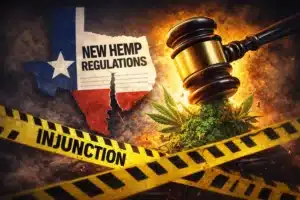
Granted a Temporary Restraining Order (TRO)
Allowed continued sales of THCA flower—for now
Set a Temporary Injunction Hearing for Friday, April 23 at 9 AM
That hearing is expected to be pivotal.
It could decide:
Whether THCA flower remains legal in Texas
How aggressively the state can regulate hemp moving forward
Whether small operators survive the next phase of enforcement
A Pattern of Consequence
Across three very different cases, a pattern emerges:
Alex Jones → financial accountability at scale
Sweet Sensi → industry-level precedent and media scrutiny
THCA litigation → the future of hemp commerce in Texas
And in each instance, Judge Maya Guerra Gamble has been at the center.
A Publisher in the Crosscurrents
From appearing in an HBO documentary about Alex Jones…
To having my magazines entered into court as evidence…
To now covering—and being part of—the ongoing fight over hemp…
This isn’t just reporting from the sidelines.
It’s being in the middle of it.
What Happens Next
All eyes are now on the April 23rd injunction hearing.
What’s decided in that courtroom could:
Reshape the Texas hemp market
Determine the fate of THCA flower
And once again place Judge Gamble at the center of a high-impact ruling
Final Word
Some stories you cover.
Others, you live through.
This one has been both.

A Texas District Court Just Hit Pause on Texas’ Hemp Crackdown
There are moments in a policy fight when the noise stops working—when all the bluster, press conferences, and scare tactics run headlong into a judge who doesn’t care about any of it and just asks one simple question: what does the law actually say?
April 10 was that moment.
What followed was less a legal argument than a slow-motion collapse. The State’s lawyer looked like a man who brought a water pistol to a cattle drive—outmatched, outgunned, and increasingly aware of it. As the court pressed in, the case didn’t just weaken, it unraveled, failing the most basic requirement of any courtroom: say something with a straight face and back it up.
They couldn’t.
Because when it came down to brass tacks, the trifecta wasn’t even close. The facts weren’t on their side. The statute wasn’t on their side. And the Constitution sure as hell wasn’t on their side.
And a Texas judge noticed.
April 10, 2026 is going to stick. Not because it ends the fight, but because it exposed it. Strip away the politics, put the argument under oath, and the prohibitionist case folded like a cheap lawn chair in an August heatwave.
They didn’t just lose.
They got their hat handed to them.
A Travis County district court issued a Temporary Restraining Order halting enforcement of Texas’ latest hemp rules — a sweeping regulatory scheme that, in plain terms, attempted to rewrite the law without bothering to ask the Legislature. For an industry that has spent years navigating shifting goalposts, administrative improvisation, and the occasional outbreak of outright hostility, this order lands not merely as a procedural win. It’s a judicial rebuke — precise, methodical, and rooted in the first principles of administrative law.
What the State Tried to Do
The core issue, stripped of regulatory camouflage, couldn’t be simpler. Texas law defines hemp using a delta-9 THC concentration threshold of 0.3% on a dry weight basis. That’s the statute. That’s the line the Legislature drew. What DSHS attempted was to swap that framework for a “total delta-9 THC” or “acceptable hemp THC level” standard — a different chemical metric, a different legal universe, achieved entirely through rulemaking.
The court saw through the maneuver immediately. The rules, it found, “effect a substantive change in the governing law through rulemaking rather than implementing the statute as written.” That’s not a technical infraction. That’s a separation-of-powers problem — the kind courts take personally. Agencies are creatures of statute. They implement the law. They don’t rewrite it because they’ve decided they’d prefer a different answer.
Why the Court Moved Immediately
Temporary restraining orders don’t come easy. The standard demands a showing of probable success on the merits and imminent, irreparable harm. The plaintiffs cleared that bar with room to spare.
Enforcement of these rules, the court concluded, would fracture the entire hemp supply chain — manufacturing, testing, transport, retail — and effectively force businesses to shut down, abandon Texas, or face enforcement actions tied to standards no legislature ever authorized. The harm here isn’t hypothetical; it’s operational collapse. Supply chains break. Customer relationships vanish. Goodwill, once gone, doesn’t file a refund claim. These aren’t losses that can be tabulated and made whole later. They’re structural — and that’s precisely why the court found them irreparable.
A Statewide Industry, Not a Niche Dispute
One of the ruling’s more consequential passages is its recognition of scope. Processors, manufacturers, distributors, and retailers all operate within the same regulatory ecosystem. A flawed rule doesn’t stay politely contained — it propagates. Limiting relief to the named plaintiffs would have been a legal gesture, not a remedy. Effective relief required restraining enforcement broadly against similarly situated businesses, and the court said so plainly.
That finding matters beyond the immediate case. It signals that the judiciary understands the scale of what’s at stake here and isn’t prepared to treat a statewide industry like a zoning dispute.
The Public Interest Argument They Didn’t Expect to Lose
Perhaps the most quietly devastating section of the order is its treatment of the public interest — the argument opponents of the hemp industry have been running for years as if it were their exclusive franchise.
The court declined to rent it to them.
Instead, it recognized that consumers across Texas rely on hemp-derived products for legitimate, documented purposes: chronic pain, PTSD, sleep disorders, and as alternatives to alcohol and pharmaceuticals that carry their own considerable risks. Many of those consumers are veterans. The court also acknowledged what any honest policy analyst already knows: removing lawful products from the market doesn’t extinguish demand. It reroutes it — toward less regulated, less safe, or outright illicit alternatives. That’s not an industry talking point. That’s a judicial finding, and it will be difficult to walk back.
What the TRO Actually Does
The order is operational, not symbolic. The state is now restrained from enforcing the rules’ substitution of a “total THC” standard for the statutory delta-9 threshold, along with the enforcement mechanisms dependent on that framework — penalties, product embargoes, and license actions built on provisions the Legislature never passed.
The practical effect is a restoration of the status quo ante — the regulatory environment as it existed before March 31, 2026. Not perfect rules. Not permanent rules. Lawful ones. And for now, that’s enough to keep an industry running.
What Comes Next
A hearing on a temporary injunction is set for April 23, 2026, where the legal questions will be litigated more fully and the state will have its opportunity to defend the rulemaking. But the trajectory is already legible. The court has signaled skepticism grounded in statutory interpretation and administrative law doctrine — skepticism the state will struggle to overcome without retreating from its current position.
The strategic lesson here is simple enough. When the political process gets captured by narrative, the legal system becomes the venue of last resort. When the record is strong — when the facts, the statute, and the economic realities align — courts still function as a corrective. There’s a durable tendency in Texas politics to treat enforcement power as though it were synonymous with legal authority. This order draws a bright line between the two.
The state can regulate hemp. What it cannot do is redefine it. That distinction now sits where it always belonged: in the hands of the Legislature, not in the hands of whoever is running the rulemaking process on any given Tuesday.

Washington’s Two-Handed Approach to Hemp
Medicare just became the nation’s first large-scale, reliable buyer of hemp — provided you are old enough, sick enough, and compliant enough to qualify. Everyone else — the twenty-something vaping a delta-8 cart in Austin, the Hill Country soccer mom with a bag of sleep gummies — is staring down a federal crackdown capable of erasing most of the existing retail market within a year. That split screen is the essential fact of American drug policy in 2026: Grandma’s CBD has received its federal blessing, while corner-store delta-8 is being fitted for the gallows.
The $500 Olive Branch, and What It Actually Means
On April 1, the Centers for Medicare & Medicaid Services quietly activated a pilot program allowing certain seniors to receive up to $500 annually in hemp-derived products through participating provider groups. Don’t mistake this for a subsidy program or a reward card you swipe at the Buc-ee’s hemp counter. Beneficiaries cannot walk into their local shop, save the receipt, and bill Washington. Instead, CMS will reimburse organizations operating inside select Innovation Center models — ACO REACH, Enhancing Oncology, and LEAD — up to $500 per eligible patient, with those organizations controlling which products are furnished as part of clinician-guided care plans. The federal government is not subsidizing brands. It is commissioning a tightly controlled cannabinoid experiment on its own terms.
The strings attached are considerable. Products must be hemp-derived and remain within the 0.3 percent delta-9 THC limit established by the 2018 Farm Bill, along with a hard cap of only a few milligrams of total THC per serving. Inhalables, synthetics, and anything with obvious intoxicating potential are excluded. Certain patients — those with disqualifying conditions including some substance use disorders and serious pulmonary disease — are carved out entirely. Dollars flow to accountable care organizations and similar entities, not to beneficiaries directly, which means clinicians and administrators control the tap. For Texas seniors, particularly in rural communities, “legal hemp” is about to acquire a respectable institutional twin: doctor-approved, chart-notated, dispensed through credentialed intermediaries rather than the shop on the frontage road.
FDA’s Wink and Nod — and Who It Leaves Out
To prevent the pilot from colliding with existing law on its first day, the Food and Drug Administration issued a new enforcement memorandum focused on Medicare-linked hemp products. The agency has spent years insisting that CBD in food and supplements occupies an unresolved regulatory gray zone. Now it is signaling a narrow pocket of “enforcement discretion” — an official look-the-other-way — when CBD is dispensed under clinician guidance inside CMS models and meets strict safety, labeling, and potency standards.
That carve-out does not extend to the broader Texas hemp marketplace. Retail tinctures, gummies, beverages, and vapes sold directly to consumers remain burdened by the same unresolved FDA questions, patchwork state rules, and ever-present risk that a compliance misstep converts inventory into contraband. Even brands that have invested seriously in rigorous testing, GMP-style production, and responsible labeling gain no special status from the fact that CMS is quietly paying for distant cousins of their products. Washington has blessed cannabinoid use in a narrow, medicalized lane — and left the general market precisely where it was, except for one item buried in a shutdown bill that threatens to blow everything else up.
The 0.4mg Time Bomb
While the Medicare pilot is launching, a separate piece of federal policy is counting down. Buried in last year’s government funding package to end a shutdown, Congress rewrote the federal definition of “hemp” to impose a hard ceiling of 0.4 milligrams of total THC per finished container — in addition to the already-familiar 0.3 percent delta-9 THC by dry weight. Any hemp-derived cannabinoid product exceeding that threshold will, once the law takes full effect, no longer qualify as hemp at all.
The numbers involved are not abstractions. Lawyers and analysts tracking the change warn that the cap would disqualify virtually all existing full-spectrum and intoxicating hemp products, along with a meaningful share of mainstream CBD items that contain trace THC exceeding the 0.4mg floor across a full bottle. Trade groups and beverage-law specialists estimate that 95 percent or more of current ingestible hemp products are over the line. In Texas alone, estimates peg the hemp market at roughly $8 billion, supported by thousands of jobs in farming, processing, distribution, and retail — an industry that would be, in the words circulating through trade commentary, “effectively shut down” if the cap is enforced as written. What was packaged inside the Beltway as a fix to the “intoxicating hemp loophole” looks, from the I-35 corridor, like a controlled demolition of an industry Washington once invited people to build.
Texas: Fresh Off a Victory, Walking Into an Ambush
No state illustrates the whiplash more vividly than Texas. Earlier this year, a hard push to ban hemp-derived THC products — spearheaded by Lt. Gov. Dan Patrick, backed by substantial Republican leadership — ran headlong into a mobilized hemp industry and a governor who ultimately vetoed the ban. The fight was real: hearing rooms filled, phone lines lit up, and small business owners made the case that prohibition would gut a multi-billion-dollar market. When the veto ink dried, many Texas operators concluded they had bought themselves at least a few years of breathing room.
Then came the federal shutdown deal. Buried in that compromise is the 0.4mg cap that accomplishes, at the national level, almost exactly what the failed Texas ban would have accomplished within one state. Nearly all consumable hemp products with any meaningful THC content become unlawful — not just in Houston and Lubbock but in Boise and Buffalo. The same operators who spent months fighting Austin now find themselves on the receiving end of a Washington decision they had virtually no hand in shaping. The sense of ambush is not rhetorical. It is palpable in every industry conversation and in local coverage from San Antonio to Dallas.
A Split Screen Made for Political Conflict
The juxtaposition is difficult to ignore. On one side of the screen, Medicare dips a cautious institutional toe into hemp, allowing clinicians in select models to furnish carefully constrained CBD and low-THC products as part of structured care plans. On the other, Congress and federal agencies have redefined hemp in a way that treats nearly anything beyond a trace as beyond the pale. One program recognizes cannabinoids as legitimate tools for managing pain, sleep, and chronic conditions — provided they arrive small, boring, and physician-mediated. The other treats any cannabinoid product that people actually choose to buy as a loophole to be sealed.
For Texas officeholders, this creates a set of choices that will not stay quiet. Supporting the federal 0.4mg cap means endorsing a Washington compromise that threatens to dismantle an $8 billion in-state industry that their own voters just finished defending against a home-grown ban. Backing the Medicare pilot, on the other hand, means conceding that cannabinoids are legitimate medicine for the very population most likely to appear in Republican primary elections — which undercuts a good deal of the rhetoric used to justify state-level crackdowns. Trying to ignore the contradiction does not make it disappear. Washington is now setting the terms for a sector that Texas policymakers thought they had partially tamed on their own.

Two Experiments, One State on the Line
From a policy standpoint, the United States is running two concurrent experiments. In the Medicare pilot, CMS and its partners will gather data on whether clinician-guided hemp products reduce pain, improve sleep, or lower downstream costs in selected patient populations, using the $500 annual ceiling as both incentive and constraint. In the broader economy, the new hemp definition and 0.4mg cap will test how resilient an industry can be when its core products are redefined into illegality by a few lines in a funding bill nobody was watching closely enough.
For Texas, which embraced hemp as a politically viable middle ground when broader cannabis reform remained a bridge too far, the stakes of both experiments are anything but theoretical. Producers, processors, and retailers were told the rules: test your products, get licensed, pay your taxes, and you can build a durable business under state and federal law. Now they are learning that the most important rule was always subject to renegotiation in a distant capital, with local investment and livelihoods treated as acceptable collateral. Whether Texas responds to that reality with the same ferocity it brought to Austin, or accepts it as the price of playing in a federally defined market, will say a great deal about whose experiment this actually is — and who gets to survive it.
- 1
- 2
