Over eight in ten US healthcare professionals acknowledge cannabis’ therapeutic efficacy and an even greater percentage say that it should be legal for medical purposes, according to survey data published in the Journal of Cannabis Research.
Eight hundred and seventy-nine healthcare professionals – including mental health professionals, registered nurses, and physicians – participated in the survey.
Consistent with prior surveys, “most respondents (>85 percent), regardless of their role in healthcare, believed cannabis to have legitimate therapeutic uses and had patients who used cannabis. Furthermore, most participants were supportive of legal access to medical cannabis, open to using it in their own practice, and interested in receiving further training to do so.”
Overall, 95 percent of respondents expressed support for the legal medical use of cannabis and 74 percent said that they personally would recommend cannabis therapy to their patients. Eighty-nine percent of respondents acknowledging having patients who are current cannabis consumers.
Despite cannabis’ growing favorability among healthcare professionals, less than one-third of participants acknowledged having received “formal clinical training” regarding how to “integrate medical cannabis into their practice” – a finding that is also consistent with other surveys of healthcare providers.
Commenting on the survey data, NORML’s Deputy Director Paul Armentano said: “The use and efficacy of medical cannabis is now widely accepted among healthcare professionals. As more physicians, nurses, and others integrate medical cannabis into their clinical practices, it is vital that medical associations, institutions, and educational curricula similarly incorporate and embrace cannabis as a mainstream and established therapeutic option for patients.”
The full text of the study, “Knowledge, attitudes, and concerns about medical cannabis among US healthcare professionals,” appears in the Journal of Cannabis Research. Additional information appears in the NORML Fact Sheet, ‘Health Clinicians’ Attitudes Toward Cannabis.’
Flower of the Year & Beverage of the Year Competition Underway
The race for the 2026 Blazed THC Challenge is officially underway as Blazed Magazine prepares to recognize the best products in the industry during the week of the CHAMPS Trade Shows in Austin this October.
The mission is simple: bring together some of the most respected brands, personalities, cultivators, and beverage makers in the industry to determine who will earn the titles of Flower of the Year and Beverage of the Year.
This year’s competition will feature ten brands in each category, creating what is shaping up to be one of the most anticipated independent cannabis competitions in the Southwest.
The Flower of the Year division is already assembling an impressive lineup of cultivators and brands looking to claim the 2026 championship. Serving on the judging panel so far are Scott Brown of Zour Stash and comedian Stoner Rob. Blazed Magazine is currently seeking three additional judges to complete the five-person panel responsible for evaluating this year’s flower entries.
Early entries in the Flower category include Pur Life, Vibes Cannabis, Bigz Recreational, Errganix, and Wyatt Purp. With five brands already committed, Blazed Magazine is actively seeking five additional flower brands to complete the field of ten competitors.
The question facing cultivators across the region is simple: Can your flower defeat the field and become the 2026 Blazed Flower of the Year?
The Beverage of the Year division is shaping up to be one of the most competitive categories of the entire challenge. Leading the field is Legacy Sponsor South Beach Brewing Company, the beverage brand associated with rapper Rick Ross. Joining the competition are Cheech & Chong’s High and Dry, Lyfted Lemonade, Wyatt Purp Seltzer, Looper D9 Sodas, and Rizzy Extra Lemonade Tea.
The Beverage Challenge is designed to showcase the rapid growth and innovation occurring within the hemp-derived beverage sector throughout Texas and the Southwest, a category many believe represents one of the fastest-growing segments of the industry.
The timing could not have been better for the Blazed team to attend the Hemp Beverage Expo in Austin last month, where staff members made valuable industry connections and opened discussions with prospective competitors and sponsors for the 2026 competition.
Those relationships are already helping fill out the Beverage of the Year field and are expected to bring several additional regional and national brands into the competition before entries close later this year.
Blazed Magazine intends to present the awards during the week of the CHAMPS Trade Shows in Austin on October 14th, bringing together competitors, judges, retailers, distributors, and media partners for one of the largest cannabis industry gatherings in Texas.
The target field for the inaugural competition remains straightforward: ten Flower brands, ten Beverage brands, two champions, and one full year of bragging rights.
Blazed Magazine welcomes submissions from brands interested in joining either category and completing the 2026 lineup. Whether your specialty is premium flower or innovative hemp beverages, now is the opportunity to compete against some of the biggest names already entered into the challenge.
For information regarding participation, sponsorship opportunities, or judging inquiries, contact Russell Dowden at blazed@stonednews.com, call 575-578-4928, or reach the Austin office at 512-897-7823.
Additional information, rules, and registration details are available at BlazedNews.com/THC-Challenge.
Blazed Magazine’s message to the industry remains simple:
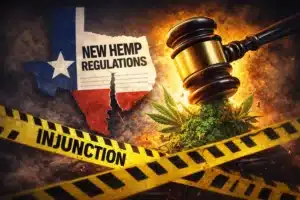
Texas Begins Enforcing New Total THC Rule: What the DSHS Crackdown Means for Hemp Retailers
The Texas Department of State Health Services (DSHS) has begun actively enforcing new Consumable Hemp Program rules that dramatically change how THC is measured in hemp products, creating significant consequences for retailers, manufacturers, distributors, and consumers across Texas.
The agency’s enforcement centers on a Total THC calculation performed on a dry-weight basis. Unlike previous interpretations that focused primarily on Delta-9 THC, the new methodology includes THCA after it is converted into Delta-9 THC through decarboxylation—the process that occurs when cannabis flower is heated or smoked.
For much of the Texas hemp industry, this is more than a testing change. It effectively places most THCA flower products outside the state’s legal hemp definition.
The curious timing in this reversal in their approach happened shortly after The Texas Hemp Business Council or (THBC) filed a motion for rehearing. Allegedly, they were not properly enforcing the new rules and that DSHS therefore had waived it. This move was extremely controversial in the Texas Hemp Industry, particularly for those who sell flower. The advocacy lobby team at (THBC) is largely funded by Hometown Hero of which flower is not a product the company sells or offers.
Why It Matters?
Because most hemp flower naturally contains THCA that converts into Delta-9 THC when heated, many products that previously passed compliance testing may now exceed Texas’ legal THC limit.
Retailers carrying smokable hemp products, pre-rolls, and certain concentrates could face increased regulatory scrutiny as DSHS expands enforcement efforts.
The industry argues that these rules fundamentally reshape the marketplace through administrative rulemaking rather than legislative action, and multiple legal challenges continue to move through Texas courts.
What Retailers Should Expect?
As if the water faucet being turned on again and off again multiple times since March 31st… what should Texas retailers expect next?
Businesses should review inventory, certificates of analysis, supplier testing protocols, and compliance documentation while monitoring ongoing litigation that could affect enforcement. Or reach out to their office for further clarification that information is at the end of this article.
The new rules impact:
– THCA flower
– Pre-rolls
– Smokable hemp products
– Testing standards
– Retail compliance requirements
– Product sourcing and inventory decisions
Industry Response
Texas hemp advocates maintain that DSHS has exceeded its statutory authority by adopting a Total THC standard that was not explicitly enacted by the Texas Legislature.
State regulators, meanwhile, maintain that the updated enforcement is intended to ensure products sold as hemp remain within legal THC limits established under Texas law.
The legal battle over these rules is expected to continue throughout 2026 and may ultimately determine the future of the Texas hemp flower market.
Some feel that the flower market in Texas has somehow been hijacked from the TCUP program with the Delta-9 status. But Texas lawmakers are still at least a session or two away from yet offering a smokable flower option.
Blazed Magazine will continue monitoring enforcement activity, court proceedings, and industry response as the regulatory landscape evolves. Businesses with questions regarding compliance should consult qualified legal counsel and stay informed through official DSHS guidance.
For regulatory clarification regarding the Consumable Hemp Program, DSHS identifies:
Jessica Fierros, RS
Manager, Consumable Hemp Branch
Texas Department of State Health Services
Office: 512-231-5656
Cell: 512-217-1319
Email: Jessica.fierros@dshs.texas.gov
This contact information is provided as a public regulatory resource for businesses seeking clarification regarding Texas Consumable Hemp Program enforcement.
For generations, cannabis opponents leaned heavily on one of prohibition’s most familiar
warnings: smoke enough marijuana, and your lungs would inevitably pay the price much like
cigarettes.
But one of the most significant long-term pulmonary studies ever conducted tells a far more
nuanced story.
Published in the Journal of the American Medical Association, the federally funded CARDIA
study followed more than 5,000 young adults over a 20-year period, examining how both
tobacco and cannabis impacted respiratory health over time. Researchers entered the study
expecting cannabis smokers to show a similar pattern of declining lung function seen in tobacco
users.
The data surprised them.
While cigarette smokers experienced the expected progressive reduction in pulmonary
performance, moderate cannabis users largely did not. In fact, many cannabis consumers
maintained normal lung function, and some even demonstrated slightly increased forced vital
capacity, a key measurement of how much air the lungs can hold, compared to both non-smokers
and tobacco smokers.
This finding became one of the more controversial outcomes in cannabis respiratory research,
largely because it challenged decades of public assumptions.
Dr. Donald Tashkin, a UCLA pulmonologist and one of the most respected researchers in
cannabis lung studies, spent years investigating whether marijuana smoke carried the same long-
term dangers as tobacco. His work consistently found that while heavy cannabis smoking could
contribute to airway irritation and bronchitis-like symptoms, it did not produce the same strong
link to emphysema, severe lung damage, or lung cancer that tobacco smoking clearly
demonstrated.
That distinction is critical.
For decades, anti-cannabis messaging often blurred the line between tobacco and marijuana
smoke, implying similar health outcomes despite mounting evidence that their long-term
physiological effects may differ substantially.
Researchers have proposed multiple reasons for the disparity. Cannabis users generally smoke
less frequently than tobacco users, often consume fewer total inhalations per day, and
cannabinoids themselves may interact differently with inflammation and respiratory pathways.
Some experts have even suggested that the deep inhalation techniques common among cannabis
consumers could contribute to stronger respiratory muscle conditioning, though this remains an
area requiring further study.
image of lungs undamaged by cannabis smoke, symbolizing health benefits- image adobe
To be clear, none of this means smoking cannabis is harmless.
Combusting plant material of any kind introduces irritants and toxins into the lungs. Heavy
cannabis use can still trigger chronic cough, increased phlegm production, and airway
inflammation. Alternative consumption methods such as vaporization, edibles, tinctures, or
beverages may ultimately offer safer long-term respiratory options.
But the larger takeaway remains important: cannabis does not appear to fit neatly into the same
respiratory risk profile as tobacco, despite years of political rhetoric suggesting otherwise.
For the modern cannabis movement, these findings reinforce an increasingly familiar theme:
much of what society was taught about cannabis during the height of prohibition was often
exaggerated, incomplete, or filtered through ideological agendas rather than objective science.
As legalization expands and research barriers continue to fall, studies like CARDIA help reshape
the conversation from fear-based assumptions to evidence-based understanding.
Cannabis is not a miracle substance, nor is it entirely without risk.
But when one of America’s largest long-term respiratory studies found that moderate cannabis
users often maintained healthier lung function than expected, it became clear that the plant’s
health profile is far more complex than decades of propaganda ever allowed.
In the end, perhaps the most dangerous thing about cannabis was never the smoke itself.
It may have been the misinformation surrounding it.
Did DSHS Just Tell the Hemp Industry to Ignore Its Own Rules Until After the Election?
There are moments in public policy when the mask slips.
According to a motion filed Sunday in the Fifteenth Court of Appeals, representatives of the Texas Department of State Health Services have allegedly been telling licensed hemp businesses not to worry about complying with some of the agency’s most controversial new hemp regulations because those provisions are not currently being enforced—and may not be enforced until after November.
Yes, November.
If true, the implications are staggering. Not merely because regulators would be quietly suspending enforcement of rules they spent months promulgating and defending in court, but because the explanation allegedly offered by agency personnel raises an even more troubling possibility: that politically inconvenient enforcement actions are being deferred until voters have cast their ballots.
The allegation appears in a Motion for Rehearing filed by the Texas Hemp Business Council and other plaintiffs challenging DSHS’s new hemp rules. The filing includes sworn affidavits from industry figures Lukas Gilkey and Kevin Salganik describing recorded conversations with a senior DSHS inspector. According to the motion, the inspector stated that DSHS legal staff and supervisors had instructed personnel not to enforce the agency’s new “total THC” standard and to revert licensing fees to their previous levels.
More remarkably, the inspector allegedly told one caller that “November” represented the likely timeline because “midterms and a lot of other stuff comes open.”
One need not be especially cynical to understand why such a statement might attract attention.
A Curious Change of Heart
Only weeks ago, Texas argued to the Court of Appeals that maintaining an injunction against the new rules would substantially harm the state by preventing DSHS from enforcing its revised regulatory framework. The state vigorously opposed temporary relief, insisting that the agency needed the ability to immediately implement its new total THC standard and dramatically increased licensing fees.
Yet, according to the newly filed motion, once the appellate court dissolved the injunction, DSHS personnel allegedly began telling industry participants the exact opposite.
“Don’t worry about total THC,” one inspector allegedly told a caller. “We’re not going to enforce anything with total THC.”
Another statement attributed to the same inspector is even more direct: “Something has changed. We’re not doing total.”
If these statements accurately reflect agency policy, the obvious question is simple: what changed?
Neither DSHS nor the Attorney General’s office has publicly announced any suspension of enforcement. No emergency guidance appears to have been issued. No formal rulemaking has been initiated. Instead, according to multiple industry participants, the agency has apparently been communicating this information privately, one telephone call at a time.
Regulation by whisper campaign is an unusual administrative model.
Government by Ambiguity
The immediate casualty of such an approach is legal certainty.
Texas hemp operators occupy one of the most heavily scrutinized and politically contentious regulatory environments in the state. Licenses, inventory, contracts, supply chains, laboratory testing, insurance coverage, and financing decisions all depend upon businesses understanding what the rules are and, equally important, whether those rules will actually be enforced.
At present, industry participants appear to be confronting an impossible dilemma.
Should they comply with the newly adopted total THC standard—potentially destroying existing inventories, disrupting supply chains, and imposing massive costs—or should they rely on verbal assurances from DSHS personnel that the rules are not presently being enforced?
Neither option is attractive.
Businesses that continue operating under preexisting standards risk future enforcement actions if the agency reverses course. Businesses that voluntarily comply with rules the agency itself is allegedly declining to enforce may simply put themselves out of business unnecessarily.
This is not regulatory oversight. It is regulatory roulette.
The Election Question
The most explosive aspect of the filing is, unsurprisingly, political.
The hemp plaintiffs suggest that DSHS’s alleged enforcement pause may reflect an effort to avoid public backlash before the November elections. The evidence offered for this proposition is limited principally to the inspector’s reported comments regarding “November,” elections, and future enforcement.
Whether a court ultimately finds such allegations persuasive is another matter entirely. Judges are generally reluctant to infer political motives absent substantial evidence, and state officials would undoubtedly deny that electoral considerations play any role in enforcement decisions.
Nevertheless, the allegation itself highlights an uncomfortable reality facing Texas policymakers.
For the last two legislative sessions, elected officials have repeatedly portrayed the hemp industry as an urgent public health threat requiring immediate and aggressive intervention. If that characterization is accurate, delaying enforcement until after an election would be difficult to justify. Legitimate public dangers, after all, do not customarily observe campaign calendars.
Conversely, if the agency truly believes enforcement can safely wait until November—or beyond—it inevitably raises questions regarding the urgency and necessity of the regulations in the first place.
Those are questions legislators and regulators may eventually have to answer.
The Larger Problem
Whatever happens in the litigation, the episode illustrates a deeper pathology in Texas cannabis policy.
The state has spent years attempting to maintain an increasingly implausible distinction between a tightly controlled medical marijuana program serving a relatively small patient population and a broadly accessible hemp marketplace that millions of Texans have embraced.
The resulting contradictions have produced exactly what one would expect: lawsuits, inconsistent enforcement, market instability, and administrative confusion.
Businesses are left attempting to divine regulatory intent from hallway conversations and telephone calls. Agencies are forced to reconcile statutory language with political demands. Consumers are left uncertain about which products are lawful today and which may become contraband tomorrow.
Flower of the Year
No industry—least of all one employing tens of thousands of Texans—can operate indefinitely under those conditions. Which perhaps is the point.
If the allegations contained in the hemp plaintiffs’ latest filing are accurate, the state’s regulators may have inadvertently demonstrated precisely why the Court of Appeals should restore the injunction pending appeal: because when the agency itself cannot clearly articulate what rules are in force, regulated parties cannot reasonably be expected to comply with them.
As Texas expands its Compassionate Use Program and awards additional medical cannabis licenses, the public has been assured repeatedly that applicants and their principals undergo extensive scrutiny.
That assurance is supposed to matter.
The licenses issued by the Texas Department of Public Safety are among the most valuable and tightly regulated cannabis licenses in the United States. Texans have every right to expect that regulators have thoroughly examined the backgrounds of those seeking to participate in the market.
That expectation becomes particularly important when a prominent cannabis executive connected to a Texas license award appears repeatedly in a federal Drug Enforcement Administration affidavit arising from an alleged marijuana trafficking investigation.
One such executive is Jason Vedadi.
Today, Vedadi is best known as the CEO of Story Cannabis, the multi-state operator associated with Story of Texas, one of the entities selected in Texas’ recent medical cannabis licensing expansion.
Fifteen years ago, however, his name appeared in a federal affidavit filed by DEA Special Agent Vince Sanchez in support of a seizure warrant targeting assets allegedly connected to what investigators called the “Jason Washington Drug Trafficking Organization.”
The affidavit, filed in federal court in Montana on November 15, 2011, describes an investigation by the DEA, FBI, IRS, and Montana drug task forces into what investigators believed was a large-scale marijuana cultivation and distribution enterprise operating through Montana’s medical marijuana system.
The affidavit alleges that Washington had become “a primary manufacturer/distributor of marijuana in Missoula, Montana” and that the organization had sources of supply in multiple states. It further alleges that members of the organization used various businesses and financial accounts to conceal proceeds derived from marijuana sales.
The name Touraj “Jason” Vedadi appears multiple times throughout the affidavit.
One of the most significant references appears in the section discussing Big Sky Health, a Montana medical marijuana business.
According to the affidavit, “Big Sky Health and its primary caregivers, WASHINGTON, Brent RUSSOM, and Touraj VEDADI (as listed by the State of Montana)” collectively had approximately 383 registered patients and more than 2,000 marijuana plants under Montana law.
The affidavit also recounts information allegedly obtained from a confidential source.
According to the DEA agent, a confidential source reported that Vedadi had “invested $500,000 in Big Sky Health to get the business started.”
That statement represents an allegation attributed to a confidential source and not a finding by a court.
The affidavit also references conversations allegedly involving Vedadi.
In one section, investigators describe an intercepted October 6, 2011 telephone call between Vedadi and Washington.
According to the affidavit, Vedadi asked Washington, “What’s it worth if it’s in Kalispell?”
The affidavit states that Washington replied, “To me it’s not worth anything it’s worth 23 to me.”
Investigators interpreted the exchange as a discussion regarding marijuana supply and pricing.
The affidavit concludes that investigators believed Vedadi “was offering to provide marijuana to WASHINGTON but WASHINGTON is able to obtain it from MOWER at a lower price.”
Again, that conclusion represents the DEA affiant’s interpretation contained within a warrant application. It is not a judicial finding of fact.
What makes the affidavit noteworthy in 2026 is not simply its existence.
It is the position Vedadi occupies today.
Since the period described in the affidavit, Vedadi has become one of the most successful executives in the regulated cannabis industry. He has held senior leadership positions in major cannabis enterprises and currently leads Story Cannabis, which has sought expansion into Texas through Story of Texas.
That reality creates a question that deserves an answer.
When Texas regulators evaluated the Story of Texas application, did they review the 2011 DEA affidavit?
If they did, what conclusions did they reach?
Did regulators determine that the allegations contained in the affidavit were unsupported, too remote in time to be relevant, or otherwise immaterial to the licensing process?
The public does not know. Nor has DPS publicly explained how historical allegations involving senior executives are evaluated during the licensing process.
Those questions are not accusations. They are governance questions.
No one should be presumed guilty based on allegations contained in a warrant affidavit.
Likewise, no applicant should be denied participation in a regulated market solely because his name appeared in a law-enforcement investigation fifteen years ago.
But neither should regulators be exempt from explaining how they evaluate such information when deciding who receives access to one of the most tightly controlled cannabis markets in America.
The issue is not whether Jason Vedadi committed a crime.
The issue is whether Texas regulators asked the questions that reasonable
Texans would expect them to ask.
The public has been told that suitability standards matter.
If that is true, transparency regarding how those standards are applied should matter as well.
For now, the affidavit remains a matter of public record.
So does the fact that one of the individuals named in it is connected to a company
that has now secured a place in Texas’ expanding medical cannabis marketplace.
That intersection of facts deserves scrutiny—not because it proves wrongdoing,
but because transparency is the foundation upon which public confidence in regulation must rest.
With the state’s flower ban looming in March, Texas hemp shop owners were staring at shelves full of products they suddenly might not be able to sell. Everyone was sweating – except AdamReposa.
The Austin attorney and owner of ATX Budtenders was unfazed, mostly because he’s been running a dispensary that technically sells “merch” and just happens to give away weed as a gift. He models his business after Washington DC-style dispensaries. In the nation’s capital, dispensaries dodge legal landmines by selling “services” like motivational speeches and then giving weed away as a “free gift.” Yes, that’s really the system. No, you’re not hallucinating.
ATX Budtenders leans into this model by selling t‑shirts priced from $100 to $300. If anything, Reposa admits he could be guilty of littering because his delivery drivers “toss weed into people’s yards” while dropping off shirts.
Winning in The Wreckage
The Texas Department of State Health Services’ smokable hemp ban isn’t its first attempt to choke out the industry. In 2021, the agency tried banning Delta 8 THC – a move the courts eventually put in time-out with a temporary injunction that’s still in effect five years later. In 2026, brands like Wyatt Purp sued again, hoping the Delta‑8 precedent would save them from another regulatory beatdown.
Meanwhile, Reposa’s business seems to enjoy protections that licensed flower dispensaries can only dream about.
Reposa has never depended on permission. He’s been selling his Mr. Chinga line of cannabis products for years, insisting Austin’s decriminalization efforts created a kind of de facto legalization – when the law says one thing, but everyday reality says another. In this landscape, ATX Budtenders continues to thrive, even after a January 2024 police raid that resulted in… absolutely nothing. More than two years later, no charges have been filed.
Whether he’s a visionary or a liability, Reposa’s presence makes one thing clear: Texas’ cannabis future won’t be shaped solely in courtrooms.
“They’re trying to hand the industry off to a bunch of rich people, and if we can’t win this fight, we’re f***ing losers,” Reposa said. “We’re just sitting around waiting for them to hand something to us, and that’s some pu**y ass bullsh*t if we let that happen. After all, we live in the land of ‘Come and Take it.’”
Entering a New Chapter – Personally and Professionally
At 50, Reposa is a recent divorcee who “hates dating apps and doesn’t feel bad about selling weed.”
“I’m not everyone’s cup of tea,” he said, while confirming a lack of emotional intelligence. “I’d be hard for any woman to handle. Maybe I’m not relationship material.”
Still, he’d like all the single ladies to know he’s on Tinder. Swipe responsibly.
Romance, however, is low on Reposa’s priority list. A looming hemp ban means an uptick in business for ATX Budtenders.
“My staff sucks, and I worry I’m not going to be able to keep up with my organic growth,” he said. “I need people who are worth a sh*t.”
Those who are interested in working at ATX Budtenders are encouraged to inquire by phone at 512-GAS-BUDS.
In addition to future hopes of running for Travis County District Attorney, Reposa aspires to make ATX Budtenders a nationwide brand.
“But it’s not going to be possible with my current dipsh*t staff,” he said.
This May or May Not End Well
Controversy is basically Reposa’s love language. He has been convicted of contempt of court twice, serving a collective 77 days in jail for the offenses. He has made antagonizing viral videos, and he once slapped stickers on East Austin businesses that featured the City of Austin’s seal and read, “Exclusively for White People,” to make a statement about gentrification. Subtlety is not his strong suit.
Launching ATX Budtenders fits neatly into his lifelong pattern of poking the bear. As legal hemp businesses face disruption from the state government, Reposa represents what everyone else is afraid to do. But is he exploiting the chaos or exposing the hypocrisy?
His business model may not survive forever, but for now, it exposes the strange limbo Texas has created – a place where enforcement is selective, legality is fluid, and the boldest players thrive in the cracks.
In a state at war with its own cannabis culture, Reposa is the wild card. And whether he’s right or reckless depends on who you ask.
A Strange Connection: Judge Maya Guerra Gamble, Alex Jones, and the Texas Hemp Industry
By Russell Dowden
Publisher, Blazed Magazine / Texas Hemp Reporter
There are moments where media, law, and industry collide in ways that feel almost pre-written. For me—and for Judge Maya Guerra Gamble—those intersections have happened more than once, each time with real consequences.
From Infowars to HBO: A Shared Timeline
In HBO’s “The Truth vs. Alex Jones,” I appear in the opening minutes, providing context on Alex Jones’ early days in Austin media. In 2012, I served as General Manager of Infowars Magazine, working inside the ecosystem that would later become the center of a landmark defamation case.
That case ultimately landed in Judge Gamble’s courtroom.
The $49 Million Judgment
In November 2022, Judge Gamble upheld a Texas jury’s award of roughly $49 million in damages against Alex Jones in the Sandy Hook case. It was a defining moment for media accountability—and a surreal one for those of us who had once worked in that orbit.
The Sweet Sensi Case: Where It Got Personal
The next intersection wasn’t just professional—it became personal.
During the Sweet Sensi litigation, my publications—Texas Hemp Reporter and related titles—were entered into evidence by both legal teams during discovery. That’s rare air for a publisher: not just covering a case, but becoming part of the record.
Both the plaintiff and defendant were active advertisers, and coverage of the dispute became a focal point in how the case was perceived publicly.
Tensions escalated beyond the courtroom.
On October 25, 2024, Greg Autry of Sweet Sensi ran a paid advertisement in The Austin Chronicle that directly attacked Wyatt Larew of Wyatt Purp and the Texas Hemp Reporter. It was a public shot—aimed not just at a competitor, but at our coverage.
The verdict changed that narrative.
A Texas jury ultimately found constructive fraud and other violations against Sweet Sensi—effectively vindicating Wyatt Larew and the Texas Hemp Reporter’s initial reporting on the case.
For us, it wasn’t just a legal outcome—it was validation.
Back in Court: The Fight for THCA Flower
Now, in 2026, Judge Gamble is again presiding over a case with major implications for Texas hemp.
With THCA flower representing roughly 50% of hemp product sales, the current litigation could determine the industry’s future.
So far, Judge Gamble has:
Granted a Temporary Restraining Order (TRO)
Allowed continued sales of THCA flower—for now
Set a Temporary Injunction Hearing for Friday, April 23 at 9 AM
That hearing is expected to be pivotal.
It could decide:
Whether THCA flower remains legal in Texas
How aggressively the state can regulate hemp moving forward
Whether small operators survive the next phase of enforcement
A Pattern of Consequence
Across three very different cases, a pattern emerges:
Alex Jones → financial accountability at scale
Sweet Sensi → industry-level precedent and media scrutiny
THCA litigation → the future of hemp commerce in Texas
And in each instance, Judge Maya Guerra Gamble has been at the center.
A Publisher in the Crosscurrents
From appearing in an HBO documentary about Alex Jones…
To having my magazines entered into court as evidence…
To now covering—and being part of—the ongoing fight over hemp…
This isn’t just reporting from the sidelines.
It’s being in the middle of it.
What Happens Next
All eyes are now on the April 23rd injunction hearing.
What’s decided in that courtroom could:
Reshape the Texas hemp market
Determine the fate of THCA flower
And once again place Judge Gamble at the center of a high-impact ruling
Medicare just became the nation’s first large-scale, reliable buyer of hemp — provided you are old enough, sick enough, and compliant enough to qualify. Everyone else — the twenty-something vaping a delta-8 cart in Austin, the Hill Country soccer mom with a bag of sleep gummies — is staring down a federal crackdown capable of erasing most of the existing retail market within a year. That split screen is the essential fact of American drug policy in 2026: Grandma’s CBD has received its federal blessing, while corner-store delta-8 is being fitted for the gallows.
The $500 Olive Branch, and What It Actually Means
On April 1, the Centers for Medicare & Medicaid Services quietly activated a pilot program allowing certain seniors to receive up to $500 annually in hemp-derived products through participating provider groups. Don’t mistake this for a subsidy program or a reward card you swipe at the Buc-ee’s hemp counter. Beneficiaries cannot walk into their local shop, save the receipt, and bill Washington. Instead, CMS will reimburse organizations operating inside select Innovation Center models — ACO REACH, Enhancing Oncology, and LEAD — up to $500 per eligible patient, with those organizations controlling which products are furnished as part of clinician-guided care plans. The federal government is not subsidizing brands. It is commissioning a tightly controlled cannabinoid experiment on its own terms.
The strings attached are considerable. Products must be hemp-derived and remain within the 0.3 percent delta-9 THC limit established by the 2018 Farm Bill, along with a hard cap of only a few milligrams of total THC per serving. Inhalables, synthetics, and anything with obvious intoxicating potential are excluded. Certain patients — those with disqualifying conditions including some substance use disorders and serious pulmonary disease — are carved out entirely. Dollars flow to accountable care organizations and similar entities, not to beneficiaries directly, which means clinicians and administrators control the tap. For Texas seniors, particularly in rural communities, “legal hemp” is about to acquire a respectable institutional twin: doctor-approved, chart-notated, dispensed through credentialed intermediaries rather than the shop on the frontage road.
FDA’s Wink and Nod — and Who It Leaves Out
To prevent the pilot from colliding with existing law on its first day, the Food and Drug Administration issued a new enforcement memorandum focused on Medicare-linked hemp products. The agency has spent years insisting that CBD in food and supplements occupies an unresolved regulatory gray zone. Now it is signaling a narrow pocket of “enforcement discretion” — an official look-the-other-way — when CBD is dispensed under clinician guidance inside CMS models and meets strict safety, labeling, and potency standards.
That carve-out does not extend to the broader Texas hemp marketplace. Retail tinctures, gummies, beverages, and vapes sold directly to consumers remain burdened by the same unresolved FDA questions, patchwork state rules, and ever-present risk that a compliance misstep converts inventory into contraband. Even brands that have invested seriously in rigorous testing, GMP-style production, and responsible labeling gain no special status from the fact that CMS is quietly paying for distant cousins of their products. Washington has blessed cannabinoid use in a narrow, medicalized lane — and left the general market precisely where it was, except for one item buried in a shutdown bill that threatens to blow everything else up.
The 0.4mg Time Bomb
While the Medicare pilot is launching, a separate piece of federal policy is counting down. Buried in last year’s government funding package to end a shutdown, Congress rewrote the federal definition of “hemp” to impose a hard ceiling of 0.4 milligrams of total THC per finished container — in addition to the already-familiar 0.3 percent delta-9 THC by dry weight. Any hemp-derived cannabinoid product exceeding that threshold will, once the law takes full effect, no longer qualify as hemp at all.
The numbers involved are not abstractions. Lawyers and analysts tracking the change warn that the cap would disqualify virtually all existing full-spectrum and intoxicating hemp products, along with a meaningful share of mainstream CBD items that contain trace THC exceeding the 0.4mg floor across a full bottle. Trade groups and beverage-law specialists estimate that 95 percent or more of current ingestible hemp products are over the line. In Texas alone, estimates peg the hemp market at roughly $8 billion, supported by thousands of jobs in farming, processing, distribution, and retail — an industry that would be, in the words circulating through trade commentary, “effectively shut down” if the cap is enforced as written. What was packaged inside the Beltway as a fix to the “intoxicating hemp loophole” looks, from the I-35 corridor, like a controlled demolition of an industry Washington once invited people to build.
Texas: Fresh Off a Victory, Walking Into an Ambush
No state illustrates the whiplash more vividly than Texas. Earlier this year, a hard push to ban hemp-derived THC products — spearheaded by Lt. Gov. Dan Patrick, backed by substantial Republican leadership — ran headlong into a mobilized hemp industry and a governor who ultimately vetoed the ban. The fight was real: hearing rooms filled, phone lines lit up, and small business owners made the case that prohibition would gut a multi-billion-dollar market. When the veto ink dried, many Texas operators concluded they had bought themselves at least a few years of breathing room.
Then came the federal shutdown deal. Buried in that compromise is the 0.4mg cap that accomplishes, at the national level, almost exactly what the failed Texas ban would have accomplished within one state. Nearly all consumable hemp products with any meaningful THC content become unlawful — not just in Houston and Lubbock but in Boise and Buffalo. The same operators who spent months fighting Austin now find themselves on the receiving end of a Washington decision they had virtually no hand in shaping. The sense of ambush is not rhetorical. It is palpable in every industry conversation and in local coverage from San Antonio to Dallas.
A Split Screen Made for Political Conflict
The juxtaposition is difficult to ignore. On one side of the screen, Medicare dips a cautious institutional toe into hemp, allowing clinicians in select models to furnish carefully constrained CBD and low-THC products as part of structured care plans. On the other, Congress and federal agencies have redefined hemp in a way that treats nearly anything beyond a trace as beyond the pale. One program recognizes cannabinoids as legitimate tools for managing pain, sleep, and chronic conditions — provided they arrive small, boring, and physician-mediated. The other treats any cannabinoid product that people actually choose to buy as a loophole to be sealed.
For Texas officeholders, this creates a set of choices that will not stay quiet. Supporting the federal 0.4mg cap means endorsing a Washington compromise that threatens to dismantle an $8 billion in-state industry that their own voters just finished defending against a home-grown ban. Backing the Medicare pilot, on the other hand, means conceding that cannabinoids are legitimate medicine for the very population most likely to appear in Republican primary elections — which undercuts a good deal of the rhetoric used to justify state-level crackdowns. Trying to ignore the contradiction does not make it disappear. Washington is now setting the terms for a sector that Texas policymakers thought they had partially tamed on their own.
Two Experiments, One State on the Line
From a policy standpoint, the United States is running two concurrent experiments. In the Medicare pilot, CMS and its partners will gather data on whether clinician-guided hemp products reduce pain, improve sleep, or lower downstream costs in selected patient populations, using the $500 annual ceiling as both incentive and constraint. In the broader economy, the new hemp definition and 0.4mg cap will test how resilient an industry can be when its core products are redefined into illegality by a few lines in a funding bill nobody was watching closely enough.
For Texas, which embraced hemp as a politically viable middle ground when broader cannabis reform remained a bridge too far, the stakes of both experiments are anything but theoretical. Producers, processors, and retailers were told the rules: test your products, get licensed, pay your taxes, and you can build a durable business under state and federal law. Now they are learning that the most important rule was always subject to renegotiation in a distant capital, with local investment and livelihoods treated as acceptable collateral. Whether Texas responds to that reality with the same ferocity it brought to Austin, or accepts it as the price of playing in a federally defined market, will say a great deal about whose experiment this actually is — and who gets to survive it.
Rapper turns police raid into music… and wins on free speech Afroman just proved something loud and clear:
You can turn a police raid into a hit song — and win in court.
The rapper, best known for “Because I Got High,” came out victorious in a defamation lawsuit filed by seven Ohio sheriff’s deputies after he used footage of a 2022 raid on his home in a series of music videos.
FROM RAID TO RECORD
The whole situation started when law enforcement raided Afroman’s house on suspicions of drug activity and kidnapping.
They came in heavy…
Guns drawn
House searched
Property damaged
And found nothing.
No charges. No arrests. No case.
THEN HE DID WHAT ARTISTS DO
Instead of staying quiet, Afroman flipped the script.
He took home security footage of the raid and turned it into content — dropping viral music videos, including tracks off his “Lemon Pound Cake” project.
One clip even shows an officer distracted by a cake sitting on the counter — a moment that became internet gold.
THE LAWSUIT
The deputies didn’t find it funny.
They sued Afroman for defamation, claiming:
He damaged their reputations
They faced harassment after the videos dropped.
They deserved millions in damages
(Reportedly close to $4 million.)
THE VERDICT
The court didn’t buy it.
A jury sided with Afroman, ruling that his videos and music were protected under free speech, not defamation.
After the win, Afroman summed it up in true fashion:
“We did it… Freedom of speech.”
WHY THIS MATTERS
This case hits bigger than one rapper.
It’s about:
Free speech vs. law enforcement power
Art as protest
Who controls the narrative after a raid goes wrong.
Afroman didn’t just defend himself — he turned the system into content… and beat it at its own game.
Our BLAZED TAKE
Let’s be real…
They kicked in his door, found nothing, and then got mad when he made a song about it.
That’s not defamation —
that’s storytelling.
And now there’s a legal precedent backing it up. It was absolutely hilarious watching him on the stand last week absorbing everything the DA threw at Afroman, as he stood there in his USA flag suit and sun glasses, and he leaned right back into the prossicuter, throwing body shots, 1st Ammendment, then 4th Ammendment.
As a monthly practitioner of the 1st amendment we are most proud of you Afroman and would love to get you on the podcast.
In case you missed it, a new op-ed in the Washington Examiner highlights a critical public-policy issue: the federal prohibition on intoxicating hemp products that Congress passed into law with bipartisan support last November must be fully implemented this year, without delay.
With the U.S. House Committee on Agriculture set to begin markup of the Farm, Food, and National Security Act of 2026 – also known as the Farm Bill – on March 3rd, the intoxicating hemp industry is pushing hard to keep these products on the market.
But as Diane Carlson writes, “the measure passed with a rare bipartisan supermajority of 76 senators. It reflected what harmed families, emergency physicians, leading public health and youth-serving organizations, law enforcement, regulators, and 39 state attorneys general, both Democrat and Republican, had already concluded: this loophole had become a national public-health crisis. It was causing unacceptable harm to children, families, and communities nationwide.”
Carlson, who is the co-founder and national policy director of One Chance to Grow Up, a nonpartisan, nonprofit organization that educates and advocates children’s interests in marijuana policy, goes on to note that “in the “Wild West” of the intoxicating hemp market, there are no age gates, no testing standards, no ingredient disclosures, no warnings. The only assured variable is predictable harm from those building businesses off targeting children and deceiving the public through “dupe” products and false claims.”
Background: A provision signed into law last November will end the nationwide unregulated sale of psychoactive Tetrahydrocannabinol (THC) products disguised as “hemp” or cannabidiol (CBD). These items have flooded gas stations, convenience stores and online marketplaces with gummies, vapes and drinks that can rival marijuana in potency and typically appeal to children. The prohibition is set to take effect this November, but the intoxicating hemp industry is seeking to delay implementation of the law.
The Problem: Since 2018, bad actors exploited hemp regulations to create unregulated, lab-produced intoxicants (gummies, vapes, drinks) with THC levels matching regulated marijuana markets but are sold without age gates, testing standards or ingredient disclosures.
The Harm: The consequences are real. The loophole has contributed to accidental child poisonings, emergency room visits, impaired driving incidents and serious mental health concerns.
Carlson writes “the intoxicating hemp free-for-all led to the rise of accidental child poisonings and injuries, ER visits and hospitalizations, impaired driving, and other serious physical and mental health effects, including acute psychosis that, for some, led to suicide.”
The Solution: The closure doesn’t ban hemp or eliminate CBD – it simply ensures intoxicating products can’t be marketed as “hemp” and sold in easily accessible stores and locations. Implementation cannot be delayed if we’re serious about protecting children and families.
“If a product can intoxicate, it should not be marketed as wellness ‘hemp’ and sold next to everyday candies, snacks, and drinks outside of a voter-approved marijuana dispensary.”
Congress acted. Now the law must take effect on schedule. Protecting kids from unregulated intoxicating products should not be controversial, it should be common sense.
The Texas hemp industry does not have a marketing problem. It has a credibility problem.
That distinction matters.
When legislators talk about “unregulated intoxicants,” when law enforcement conducts raids with television cameras in tow, when opponents describe the market as a public health emergency, they are not arguing about cannabinoids. They are arguing about discipline. They are arguing about whether this industry behaves like an adult.
Good Manufacturing Practice—GMP—is the answer to that argument.
GMP is not a logo. It is not a slogan. It is not a sticker on a window. It is a system. At its core, GMP means this: products are manufactured in a controlled, documented, repeatable way that ensures consistency, safety, and traceability. It requires written procedures. It requires training. It requires recordkeeping. It requires the ability to answer a simple question without hesitation: “How do you know this batch is what you say it is?”
If you cannot answer that question with documentation, you are not in a regulated market. You are in a hobby.
The federal framework for GMP in the United States exists already. The Food and Drug Administration enforces current Good Manufacturing Practice, or cGMP, standards for foods, dietary supplements, cosmetics, and pharmaceuticals. Dietary supplements, for example, are governed by 21 C.F.R. Part 111. Food facilities operate under 21 C.F.R. Part 117. These are not abstract rules. They cover sanitation controls, supplier verification, batch production records, equipment maintenance, complaint handling, and recall procedures.
Hemp-derived products sit in a complicated regulatory posture, but that does not mean they sit in a vacuum. The scientific principles of GMP apply whether a product contains vitamin C or a cannabinoid.
The core concept is control. Control of raw materials. Control of processes. Control of environments. Control of records.
Consider what that looks like in practice. A manufacturer sources distillate. Under a GMP system, that supplier is qualified. Certificates of analysis are verified and tied to lot numbers. Incoming material is logged. Storage conditions are documented. Production steps are written in standard operating procedures. Employees are trained and their training is recorded. Each batch is assigned a number. Finished goods are tested. Distribution records show where each lot was shipped. If a defect is discovered, there is a documented recall plan.
That is not bureaucracy. That is civilization.
Hemp is a plant. Plants bioaccumulate heavy metals from soil. They host microbes if improperly dried. They degrade if stored in humid environments. Cannabinoids oxidize. Residual solvents can remain if extraction is sloppy. None of this is scandalous. It is chemistry. GMP exists to manage these variables, not to eliminate business.
The uncomfortable truth is that parts of the hemp market grew faster than their infrastructure. Entrepreneurs moved at startup speed. Regulation moved at legislative speed. Public perception moved at cable news speed. Those timelines collided.
When opponents point to mislabeled potency, contaminated products, or products marketed without guardrails, they are not inventing physics. They are pointing to variance. Variance is what GMP is designed to reduce.
Here is the forward-looking reality: industries that survive scrutiny are industries that document themselves into legitimacy. The food industry did not always have Hazard Analysis and Critical Control Points. The pharmaceutical industry did not always have batch validation. They built those systems because crises forced maturity.
Hemp can build them proactively.
This is not about surrendering to overregulation. It is about seizing narrative control. An industry that can show documented SOPs, training logs, supplier verification, sanitation schedules, and traceable batch records is not “the Wild West.” It is a regulated commercial ecosystem waiting for consistent oversight.
Legislators respond to evidence. Regulators respond to structure. Courts respond to documentation.
GMP transforms debate. Instead of arguing in the abstract about “dangerous products,” the conversation becomes concrete: show the batch record, show the COA, show the sanitation log, show the training file.
When you can produce those documents without panic, rhetoric loses oxygen.
There is a deeper point here. Credibility is cumulative. It is built through systems, not speeches. If the hemp industry wants durable access to markets, capital, insurance, and mainstream retail partnerships, it must look and operate like an industry that expects to be around in ten years.
GMP is not glamorous. It is binders and databases. It is checklists and calibration logs. It is the quiet confidence of being able to say, under oath if necessary, “Here is exactly how we made this product.”
In a climate where fear-based narratives move faster than facts, the disciplined operator has an advantage. Documentation is not defensive. It is strategic.
Hemp does not need louder slogans. It needs better systems. The future of the industry will not be decided by how passionately it argues, but by how professionally it operates. Industries that master their processes earn the right to exist. Those that do not are regulated by people who assume chaos. Good Manufacturing Practice is not a burden. It is armor. And the companies that understand that first will shape what this market becomes next.
For nearly half a century, Steven Spielberg has used cinema to rehearse humanity for a moment he has never fully shown on screen: official extraterrestrial disclosure.
His protégé, J. J. Abrams, inherited this framework—and in Super 8, echoed it with near-surgical precision. When viewed alongside Close Encounters of the Third Kind, the similarities are not homage alone. They form a blueprint.
The Train Derailment: A Disclosure Trigger
In Super 8, the story detonates when a catastrophic train derailment shatters the calm of a small American town. The military swiftly arrives, sealing off the area, controlling information, and reframing the incident as a public safety concern.
In Close Encounters, the same mechanism is deployed—decades earlier.
The climactic contact event at Devil’s Tower is made possible only after a manufactured emergency: the public is told a train derailment spilled toxic chemicals, justifying evacuation. This false flag clears the area for the rendezvous while Roy Neary and others move toward the truth.
Two films. Same narrative lever.
The train derailment is not chaos—it is logistics. Domestic Normalcy Meets the Impossible
Spielberg and Abrams both anchor disclosure not in the skies—but in the living room.
Super 8
As morning routines unfold, TV news reports the derailment. Children bang toys in the background. When Joe Lamb enters the house, Charles is transfixed by a small black-and-white television broadcasting the crisis.
Close Encounters
Roy Neary watches the same kind of broadcast—alone, desperate, drinking Budweiser—as his family life collapses. The derailment near Devil’s Tower interrupts domestic despair, not adventure.
In both films:
The television is small
The image is grainy
The family is fractured
The truth arrives quietly, not spectacularly
Disclosure doesn’t crash through the roof. It leaks in through the TV.
Toy Trains, Fractions, and Repetition
Spielberg’s visual language is obsessive—and deliberate.
Roy Neary explains fractions to his son using toy train cars, just before offering a choice between Goofy Golf or Pinocchio. The banging of toys punctuates the moment—echoing later scenes of domestic unrest.
In Super 8, Joe Lamb paints model trains in his spare time. The derailment becomes personal before it becomes cosmic.
Model trains are not props.
They are preconditioning tools—symbols of control, order, and derailment. Abrams doesn’t just salute Spielberg here. He repeats the lesson. Loss of Family as the Cost of Truth. Both films are built on trauma. Joe Lamb loses his mother in a sudden industrial accident. Roy Neary loses his family—and eventually leaves Earth entirely. In both cases, disclosure costs something permanent.
This theme deepens when viewed alongside Spielberg’s later autobiographical work, The Fabelmans, where parental divorce is revealed as a defining wound. The same absence echoes through E.T. the Extra-Terrestrial, with Elliott’s father quietly gone—off in Mexico with another woman.
What will that day look like?
Contact is never free.
Truth rearranges families & Children as the Disclosure Constant
Across Spielberg’s universe—and Abrams’ continuation—children are always ready.
E.T.
Super 8
Close Encounters
Even Taken
Adults panic. Institutions lie. While Children adapt. If disclosure happens, Spielberg suggests, it will not break the young—it will expose the old.
Disclosure Day 2026: Cinema or Conditioning?
The question is no longer if disclosure will come—but how it will be framed.
Will it arrive: As a Spielberg-directed return to the genre by cinema’s greatest architect of UFO storytelling?
Or as another government-aligned narrative, laundered through Hollywood to guide public reaction?
Spielberg’s filmography already includes: Close Encounters, E.T. , War of the Worlds , Indiana Jones and the Kingdom of the Crystal Skull, A.I. Transformers, Men in Black (producer), Amazing Stories, & Taken to name a few.
Decades of preparation. Decades of normalization.
Final Thought
Spielberg never taught us to fear aliens. He taught us to fear being lied to. If Disclosure Day comes, it won’t look like a blockbuster. It will look like a news report…playing softly in the background…while families argue in the next room. The only remaining question is whether Spielberg will finally show us the moment he’s spent a lifetime preparing us to see.
For more than fifty years, the federal government has maintained a position about marijuana that almost everyone involved understood to be false. Not unsettled, not ambiguous, but false in the ordinary sense of the word. Since 1970, cannabis has been classified under federal law as a Schedule I controlled substance, a category reserved for drugs deemed to have no accepted medical use and a high potential for abuse. Heroin sits there. LSD sits there. Marijuana was placed there as a purportedly temporary measure, pending further study.
That study never came.
What followed instead was a long period of institutional pretense. Decades of crime-and-punishment and the warping of society—which supposedly the Founders based on the proposition of being classless and upwardly mobile for everyone. And eventually? States legalized medical marijuana. Doctors recommended it. Patients relied on it. Universities studied it. Courts acknowledged its use. Congress quietly funded research. Federal agencies carved out exceptions and workarounds that allowed cannabis to exist in practice while remaining forbidden in theory. Through all of this, the federal government continued to insist—on paper—that marijuana had no accepted medical use.
The lie persisted not because it was persuasive, but because abandoning it would have required admitting that an entire regulatory and enforcement architecture rested on a premise everyone knew was untrue.
To understand why that admission took half a century, it helps to return to the moment the lie was chosen deliberately.
By the time Richard Nixon took office, the promise of the civil-rights era was already unraveling. The assassination of Dr. Martin Luther King Jr. did more than remove a moral leader; it marked the point at which the federal government’s commitment to racial justice felt to many as though it receded from urgency into abstraction. No justice, no peace, cities burned, Black men wore their anger along with their black berets, black gloves and the arms our Constitution gave us an inalienable to carry for self defense—for the very first time in inescapable confrontational terms demanding justice and equality—and looking back, maybe the default decision by the “Silent Majority “ of White Americans to criminalize as many of these things as possible because fear and loathing are the natural first reaction to riots but the ability to empathize and act on that empathy by hearing and seeing and making things right—yeah, that was never gonna happen. Millions of hijacked amygdalas chose the tough talking authoritarian as a substitute for thinking and taking accountability. So, what followed was not reconciliation, but reaction. The language of reform gave way to the language of control. Equality was replaced with order.
“Law and order” was not a neutral governing philosophy. It was a reactionary response to social change, deployed to reassure a frightened majority that the upheavals of the 1960s would be contained. Nixon understood this, and he understood who would pay the price. In private conversations, he acknowledged that marijuana was “not particularly dangerous” and that the scientific case against it was weak. His concern was not public health. It was symbolism.
Marijuana had become associated—politically and culturally—with groups Nixon viewed as destabilizing: young people, antiwar activists, Black Americans, and other minorities already framed as threats to social order. Criminalizing cannabis at the highest level of federal law provided a tool that could be applied broadly, selectively, and with devastating effect. It allowed the state to exert control without formally repudiating the civil-rights commitments it had just made.
When Nixon appointed the National Commission on Marihuana and Drug Abuse, the Shafer Commission, he did so knowing the evidence was unlikely to support harsh criminalization. When the commission reported back in 1972, it confirmed precisely that. Marijuana did not warrant its treatment under federal law. Decriminalization was the rational course.
Nixon did not dispute the findings. He did not rebut the science. He ignored the report.
The decision to keep marijuana in Schedule I was not a misunderstanding; it was a choice. Nixon believed that moving marijuana would send “the wrong signal” at a moment when his administration was invested in reasserting authority. Law-and-order politics required visible enforcement and blunt tools. The War on Drugs supplied both. What followed was not subtle. It was blunt-force trauma as policy—aggressive policing, prosecutorial overreach, mass incarceration, and the degradations that fell predictably on the same communities the civil-rights movement had sought to protect.
The foundational lie—that marijuana had no accepted medical use—provided moral cover. Over time, that expedient falsehood hardened into doctrine. Administrations changed. Evidence accumulated. States adapted. Courts worked around it. Yet the classification remained, repeated long after belief in it had vanished.
This is where the analogy to Chernobyl becomes unavoidable.
By the mid-1980s, the Soviet Union was already operating inside a closed informational system. Official narratives bore little relationship to reality, but the system persisted because accuracy mattered less than conformity. Bad news was softened as it moved upward. Problems were tolerated as long as they could be managed on paper. The system functioned not because it was honest, but because honesty had become dangerous.
When Reactor No. 4 failed, the instinct was not to confront the truth, but to preserve the narrative. Engineers hesitated. Officials delayed. Ministries reassured superiors that everything was under control. Radiation spread anyway. What ultimately destabilized the system was not the explosion alone, but the revelation that the state had organized itself in such a way that telling the truth posed a greater risk than continuing to lie.
Federal marijuana policy followed the same structural logic, if at far lower human cost. The insistence that cannabis had no accepted medical use survived long after it ceased to convince doctors, patients, researchers, judges, or regulators. The system adapted not by correcting the falsehood, but by building increasingly elaborate workarounds around it. Enforcement became selective. Research was constrained. Tax policy became punitive to the point of absurdity. Banking and payment systems warped around legal fiction.
For a time, the damage was containable because it was diffuse. It affected particular industries, particular states, particular people. The broader system absorbed the stress.
Rescheduling marijuana to Schedule III marks the moment when that containment strategy fails. The gap between what the law said and what the world demonstrated grew too large to manage through euphemism and exception. Continuing to insist that cannabis had no accepted medical use began to impose greater institutional risk than abandoning the claim. Like radiation readings that could no longer be ignored, the consequences of the lie became measurable and undeniable.
This is not legalization. It is not absolution. It is the federal government quietly conceding that it can no longer maintain a position everyone knows is untrue.
History rarely turns on dramatic confessions. More often, it shifts when institutions admit—without ceremony—that denial has become more dangerous than truth. Chernobyl marked that moment for a system built on managed reality. Federal marijuana rescheduling, if it occurs, will be remembered the same way: not as the end of prohibition, but as the moment when the lie finally escaped containment.